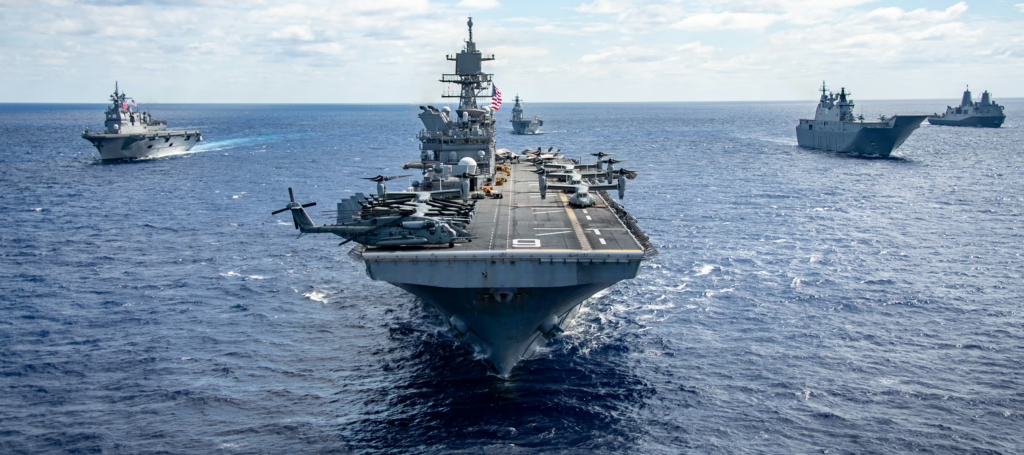

Photo caption: CORAL SEA (July 20, 2025) The forward-deployed amphibious assault ship USS America (LHA 6), flag ship of the America Strike Group, steams alongside U.S. Navy ships from the America Strike Group, Royal Australian Navy, Republic of Korea Navy, Royal New Zealand Navy, French Navy and Japan Maritime Self-Defense Force while in formation during a formation exercise as part of Talisman Sabre 25. HII’s Ingalls Shipbuilding built USS America and delivered it to the U.S. Navy in 2014. (U.S. Navy photo illustration by Mass Communication Specialist 2nd Class Cole Pursley)
July 25, 2025
HII’s Weekly News Digest is compiled every Friday by the Corporate Communications team to summarize and highlight news stories of significance to the company.
Adm. Caudle Urges Faster Sub Construction Pace To Deliver On AUKUS Promise: USNI News reported on Thursday that Adm. Daryl Caudle told members of the Senate Armed Forces Committee that the U.S. must double its Virginia-class submarine production to meet its obligations under the trilateral AUKUS agreement. He called for a “transformational improvement” in shipyard output that will require creativity, outsourcing work, and minimizing the attrition at the shipyards to increase that build rate. Breaking Defense reported Thursday that Caudle would also address the situation with USS Boise (SSN 764), saying he would consider decommissioning the sub if confirmed as chief of naval operations. Defense Daily reported Thursday that Caudle also supports leveraging international partners for ship repair and construction to relieve domestic shipyard strain. Caudle stressed that the Navy needs ships and submarines “today,” and expanding global collaboration could serve as a temporary relief valve.
Defense Companies Report Second Quarter Earnings: Defense Daily reported on Wednesday that General Dynamics had a positive second quarter driven by the company’s shipbuilding and aerospace segments. Marine Systems increased sales by 22% and operating earnings grew 19%, driven by the Virginia-class attack and Columbia-class nuclear missile submarine construction programs, said Phebe Novakovic, GD’s chairwoman and CEO, during a Wednesday earnings call. A $12.4 billion contract from the Navy in April helped drive backlog at the segment up by $14.6 billion, or 38%, to nearly $53 billion. The award covered two Virginia-class Block V submarines, “including a one of a kind special mission ship with considerable content,” she said. Overall, the company reported net income increased 12% to $1 billion, $3.74 earnings per share, from $905 million ($3.26 EPS) a year ago. Elsewhere, Lockheed Martin reported Tuesday that its second quarter profit plunged by about 80%, driven by a pretax loss of $1.6 billion, mainly linked to a classified program within its aeronautics segment. Reuters reported on Tuesday that Lockheed Martin also trimmed its 2025 profit outlook by $1.5 billion or 18% and said it now targets $6.65 billion in operating profit for the year. GovCon Wire reported on Tuesday that RTX had $21.6 billion in sales during the second quarter of 2025, marking a 9% year-over-year growth. The company reported a backlog of $236 billion at the end of the quarter, up 15% compared to the same period in 2024.
Senators Question Navy’s Slow Implementation Of GAO Recommendation: Inside Defense reported on Tuesday that congressional lawmakers want to know why the Navy has not implemented the majority of shipbuilding improvements recommended by government auditors over the past decade. The Senate Armed Services Committee’s draft defense policy bill directs the Navy secretary to deliver a report on the subject by May 2026. Since 2015, the Government Accountability Office has supplied 90 recommendations to help the Navy manage its shipbuilding portfolio, but the sea service has implemented just 30 of them, according to the bill’s accompanying report. The report requested by the committee must detail the recommendations that have been fully or partially implemented by the Navy and provide an explanation for the Navy’s lack of action on the remaining, unexecuted GAO proposals. Meanwhile, Breaking Defense reported on Friday, July 18, that the two senior Navy officials tasked with managing the service’s Shipyard Infrastructure Optimization Plan, now believe the initial price and timeline estimates of the vast undertaking are no longer viable. Known as SIOP, the plan created in 2018 entailed investing $20 billion over more than two decades to upgrade and redesign the four public shipyards across the country. Mark Edelson, SIOP’s program executive officer, and Capt. Luke Greene, the program manager, both believe the Navy continues to improve because of its ongoing execution of SIOP. To date, SIOP has delivered 45 facilities projects worth more than $1.2 billion dollars, with $6 billion invested in 47 more initiatives underway. Neither official was able to say how much more the Navy will need to spend to implement SIOP to its fullest possible extent.
| Social Media Highlight Of The Week
Posted Friday, July 18, to HII’s Facebook page:
“Built on legacy. Driven by innovation. In 2011, HII was formed when two legacy shipyards, #IngallsShipbuilding and #NewportNewsShipbuilding, joined forces to become the nation’s largest shipbuilder. Today, with the addition of our third and fastest growing division, #MissionTechnologies, we deliver the world’s most powerful ships and all-domain solutions in service of the nation, creating the advantage for our customers to protect peace and freedom around the world. |

Take a step back in time and scroll through the full timeline of our history here: https://hii.com/who-we-are/our-history/history-time-line/”
Hanwha Sends First LNG Carrier Order To Philly Shipyard: GCaptain reported on Monday that Hanwha Shipping has ordered a liquefied natural gas carrier from Hanwha Philly Shipyard. It is the first U.S.-ordered, export-market-viable LNG carrier in almost 50 years. The project will use a joint-build model, with Hanwha Philly Shipyard signing the primary shipbuilding contract and executing it in partnership with Hanwha Ocean. While a “significant portion” of construction will occur at Hanwha Ocean’s Geoje shipyard in Korea, Hanwha Philly Shipyard will handle U.S. regulatory compliance and safety certifications. Notably, the vessel will not be compliant with the Jones Act, which requires goods transported between two U.S. points to be U.S.-owned, -operated, and -built ships. The vessel will cost at least $250 million and have a capacity of 174,000 cubic meters. Meanwhile, Inside Defense reported on Friday, July 18, that Hanwha aims to begin building and delivering non-combatant auxiliary vessels to the U.S. Navy within the next decade as part of a 10-year plan. Hanwha Philly Shipyard will look to increase its annual output from a rate of one to one-and-a-half vessels today, to six-to-10 vessels per year within the next decade, according to CEO David Kim, who said the company plans to spend “multiple times” the $100 million purchase price on infrastructure upgrades in the coming years.
HII’s Weekly News Digest is produced by HII’s Corporate Communications team and posted to MyHII every Friday.
Please note: Social media is blocked on HII computers for most employees. Employees are encouraged to visit HII’s Facebook page and other social media sites on personal time and from non-work devices.
Send feedback to: HII_Communications@hii-co.com.