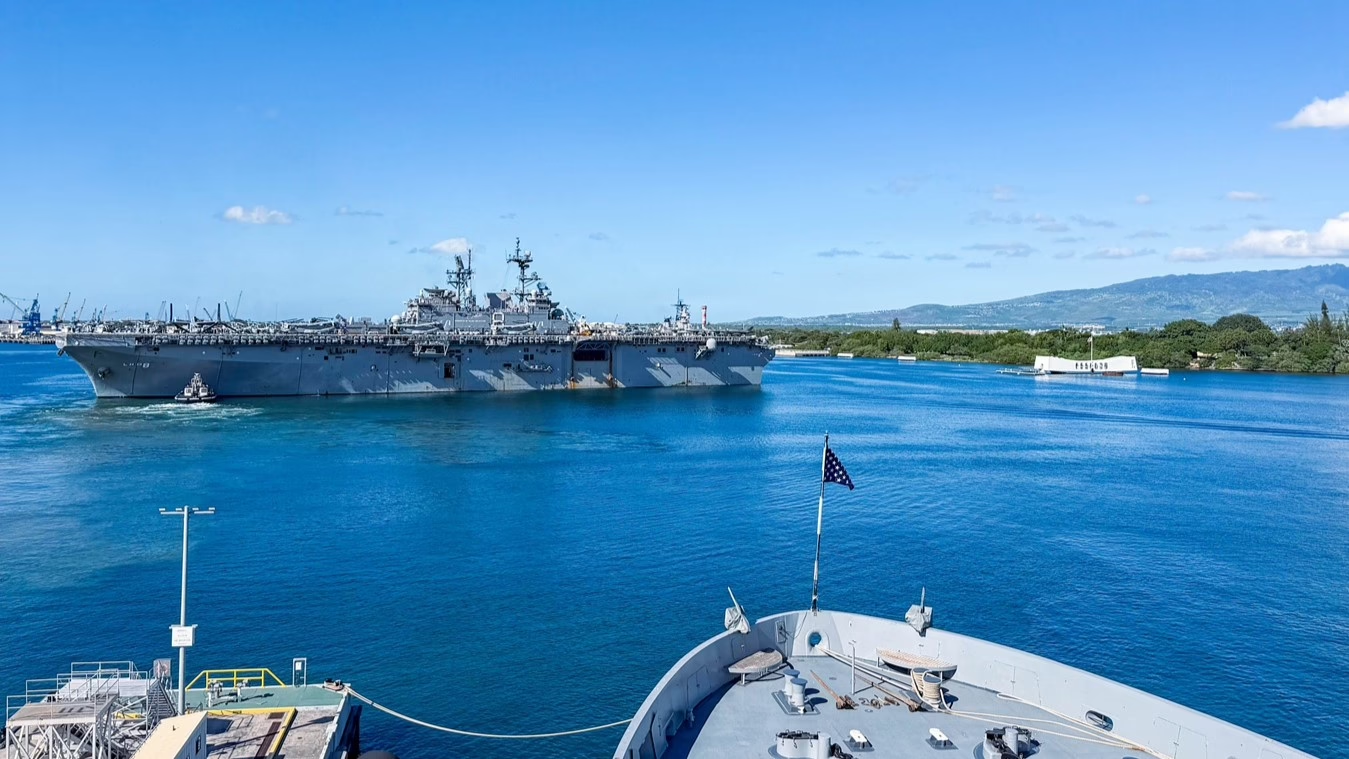
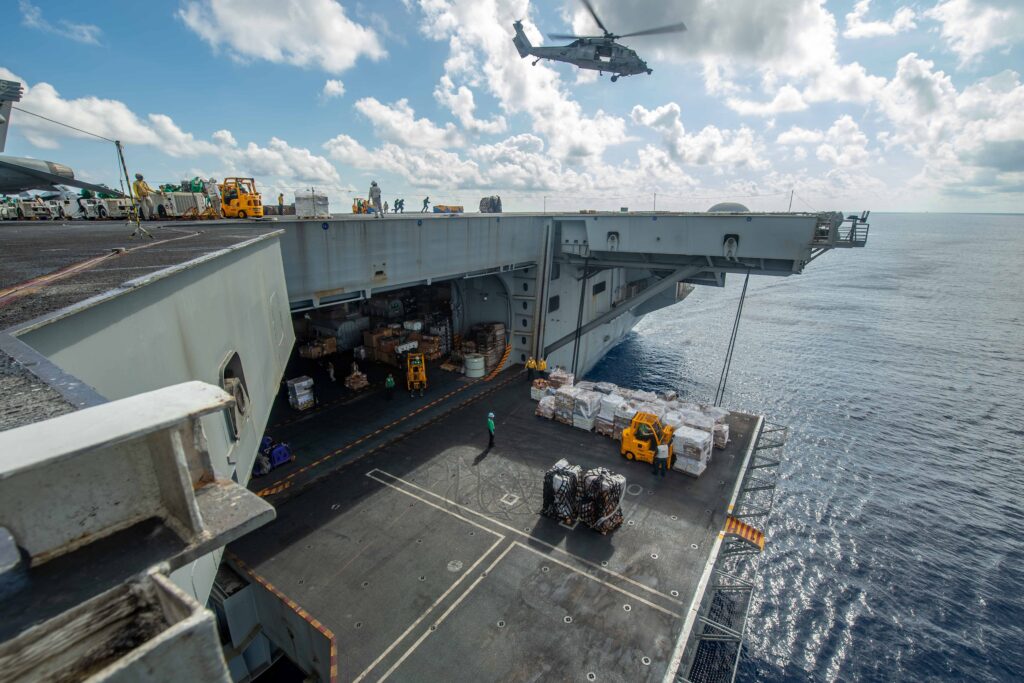

Photo caption: SOUTH CHINA SEA (May 14, 2024) Sailors move supplies during a replenishment-at-sea aboard the Nimitz-class aircraft USS Theodore Roosevelt (CVN 71), May 14, 2024. Theodore Roosevelt, flagship of Carrier Strike Group Nine, is underway conducting routine operations in the U.S. 7th Fleet area of operations. U.S. 7th Fleet is the U.S. Navy’s largest forward-deployed numbered fleet, and routinely interacts and operates with allies and partners in preserving a free and open Indo-Pacific region. (U.S. Navy photo by Mass Communication Specialist Seaman Apprentice Aaron Haro Gonzalez)
House Committee Publishes Draft NDAA: Politico reported on Tuesday that draft fiscal year 2025 National Defense Authorization Act released Monday by the House Armed Services Committee endorses buying a second Virginia-class attack submarine. Lawmakers also slashed the Pentagon’s plans for the F-35 fighter and eliminated the entire $1.2 billion Pentagon request to procure a new Constellation-class frigate, among other adjustments that continue to keep the budget within the predetermined $895 billion cap on national defense spending. The draft legislation authorizes an extra $1 billion for the Virginia-class boat. If the plan sticks, the additional sub would be incrementally funded within the budget restraints, rather than paying the entire cost of the boat upfront. Defense News reported on Tuesday that the draft House bill aims to exert additional oversight in shipbuilding. Language asks for assurances from the Navy that, before construction begins, each new block of a ship will have its detail design completed, the Navy will obtain all information from its vendors about system maturity, and specifications will be finalized.
Guertin: Navy Shipbuilders Must Better Utilize Modern Development Tools: Inside Defense reported on Wednesday that Assistant Navy Secretary for Research, Development and Acquisition Nickolas Guertin wants to see Navy shipbuilders taking advantage of the modern development tools to help reduce delays in key submarine and ship acquisition programs. Testifying on Wednesday at a Senate Appropriations defense subcommittee hearing, Guertin said commercial shipbuilders have already utilized practices involving up-front modeling to help with the acquisition and naval architecture processes. In addition to changing design practices, Guertin said the Navy needs to grow its ranks of contracting officers, naval engineers and other personnel who oversee shipbuilding programs.
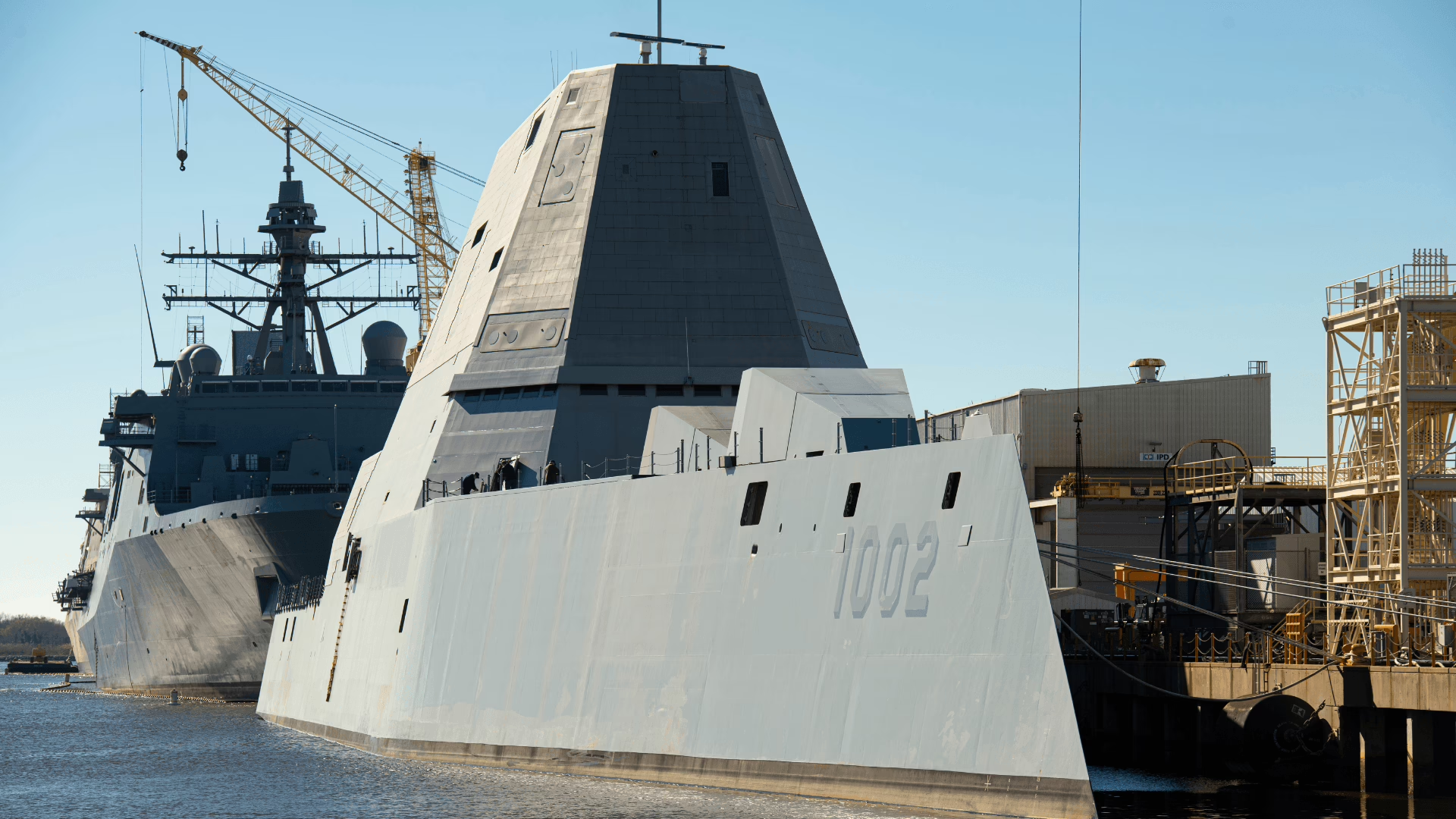
Upgrade to Conventional Prompt Strike Weapons Systems Progresses On USS Zumwalt: Naval News reported on Tuesday that workers at HII’s Ingalls Shipbuilding division have removed the first 155mm Advanced Gun System from USS Zumwalt (DDG 1000). The first-in-class guided missile destroyer arrived at Pascagoula, Mississippi, in August 2023 ahead of its modernization period. Seapower reported on Monday that USS Zumwalt is receiving technology upgrades including the integration of the Conventional Prompt Strike (CPS) weapon system. These upgrades, and the integration of the CPS weapon system, will help ensure USS Zumwalt remains one of the most technologically advanced and lethal ships in the U.S. Navy. The missiles will be delivered to the Navy onboard Zumwalt-class DDGs starting in the mid-2020s and on Block V Virginia-class submarines in the early 2030s.
AUKUS Partners’ Shipbuilding Ambitions Become Clearer: Defense News reported on Tuesday that the British Royal Navy plans to buy up to six new multirole support ships and give its future frigates the ability to attack land-based targets. Within its defense budget, the service is seeking 28 new ships to turn the tide on a shrinking fleet, said U.K. Defence Secretary Grant Shapps, at the Sea Power conference in London. The push to build new ships also comes a month after the current Prime Minister Rishi Sunak announced a $94 billion (U.S. dollar) increase in defense spending over the next six years, raising British military expenditures to 2.5% of gross domestic product. Meanwhile, Defense News reported on Wednesday that Australia will spend a record $36.8 billion (U.S. dollars) on defense during the next fiscal year, according to newly release budget documents. The figure equates to 2.02% of gross domestic product and represents a 6.3% increase from last year. The country’s navy would receive about $7.1 billion of the total defense budget, or about 19%. Spending on nuclear submarines will snowball from last year’s $317 million to $1.8 billion in the coming year, eventually reaching $3.3 billion in 2027-2028.
Social Media Highlight Of The Week 
Posted Wednesday on Mission Technologies’ LinkedIn page: “’We’re living in a time of unprecedented technological change and urgency,’ HII Executive Vice President and Chief Technology Officer Todd Borkey said. ‘There is no better time to augment HII’s existing capabilities in the areas of artificial intelligence (AI) and machine learning, edge computing, and cloud migration and modernization, to achieve first-time quality in manufacturing and deliver the advantage for HII’s customers across all domains and services.’ HII announced Wednesday that it has signed a Strategic Collaboration Agreement (SCA) with Amazon Web Services (AWS). The three-year SCA formally expands on the existing relationship between AWS and HII, in support of the company’s development and delivery of mission-critical capabilities.” |
HII’s Weekly News Digest is produced by HII’s Corporate Communications team and posted to Homeport every Friday.
Please note: Social media is blocked on HII computers for most employees. Employees are encouraged to visit HII’s Facebook page and other social media sites on personal time and from non-work devices.
Send feedback to: HII_Communications@hii-co.com.