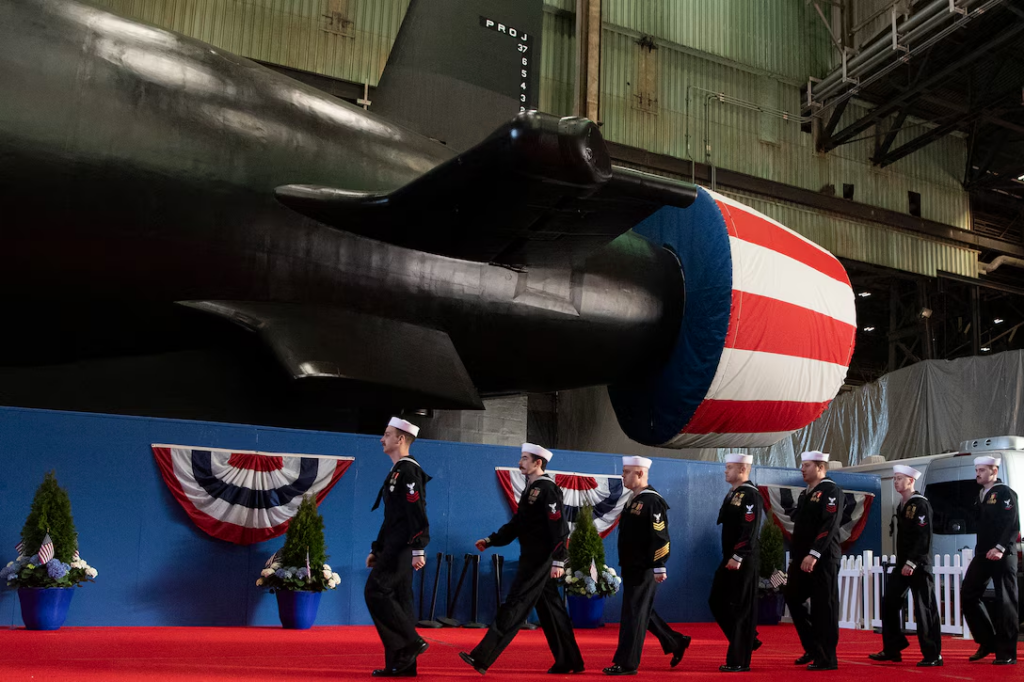

Photo caption: GROTON, Conn. (March 16, 2024) The crew of the Virginia-class attack submarine Idaho (SSN 799) march in formation during a christening ceremony at General Dynamics Electric Boat shipyard facility in Groton, Conn., March 16, 2024. The submarine was built by shipbuilders at HII’s Newport News Shipbuilding division and Electric Boat. (US Navy Photo)
March 22, 2024
HII’s Weekly News Digest is compiled every Friday by the Corporate Communications team to summarize and highlight news stories of significance to the company.
Navy Releases Long-Range Shipbuilding Plan: USNI News reported on Tuesday that the Navy’s Long-Range Shipbuilding Plan released this week maps out two paths to get to a larger fleet – one bounded by flat budgets, and a second one that seeks to reach the Navy’s goal of 381 ships the service says it needs to meet its obligation in the Pentagon’s National Defense Strategy. The major difference between the two long-term plans is the number of surface warships and combat logistics force ships. The lower-end plan would specifically see fewer small surface combatants such as frigates and littoral combat ships while maintaining the minimum number of congressionally mandated 31 amphibious warships, 12 nuclear ballistic-missile submarines and the same build rate for attack submarines that will yield 60 hulls by the 2040s. Defense News reported on Wednesday that the plan ramps up the number of ships being built in future years, including 14 ships in fiscal year 2027, 17 ships in 2031 and 18 in 2034.
BAE Picked To Build SSN-AUKUS Submarines: Reuters reported on Thursday that Australia has announced that BAE Systems will help build submarines for the trilateral AUKUS pact starting in the 2040s. The AUKUS agreement among Australia, Britain and the United States will see Australia buy up to five nuclear submarines from the U.S. in the early 2030s before jointly building and operating a new class, SSN-AUKUS, with Britain, roughly a decade later. To help alleviate strain on existing submarine manufacturers and suppliers, Australia will give Britain $3.1 billion toward design work on the conventionally armed SSN-AUKUS and expanding a Rolls-Royce plant that builds nuclear reactors for submarines. Australia has already agreed to invest $3 billion in U.S. shipyards which build the Virginia-class nuclear submarines that the U.S. is planning to sell Australia early next decade. Defense News reported on Thursday that BAE Systems and ASC – Canberra’s builder and maintainer of conventional submarines – will initially work together under a collaborative arrangement in Australia before formalizing to a more long-term joint venture.
Defense Innovation Unit Gets Boost In Remaining FY24 Budget: Defense News reported on Thursday that a compromise version of the fiscal year 2024 defense spending bill released by congressional appropriators on Thursday expands the Defense Innovation Unit’s funding to $983 million — up from the $191 million enacted the prior year. The funding increase is a signal that DIU is taking on a more central role in the Pentagon’s innovation ecosystem. The compromise bill also eliminates a proposal that would have required each military service to designate a Non-Traditional Innovation Fielding Enterprise lead who would be responsible for working with commercial industry partners and shepherding projects within the service. The final bill does require each service secretary to identify an organization with “proven competence in partnering with commercial entities” and develop plans and processes for how that office will leverage DOD-wide innovation initiatives.
Commands Submit FY25 Unfunded Priorities Wish Lists: Inside Defense reported on Tuesday that U.S. Indo-Pacific Command has sent Congress a list that identifies $11 billion in “unfunded priorities,” for the 2025 fiscal year including a range of weapon systems, munitions, sensors and military construction projects. Broken down, the list includes $3 billion for military construction, $2.7 billion for procurement, $2 billion for research, development, test and evaluation, $1.2 billion for operations and maintenance and $1.6 billion for classified programs. The top priority on the list seeks $430 million for investments in a missile defense system in Guam to protect against ballistic, hypersonic and cruise missile threats. Meanwhile, Breaking Defense reported on Wednesday that US Southern Command is asking for an additional $322.6 million to pay for 20 unfunded budget priorities. The top of SOUTHCOM’s list is $90 million for a new command and control facility at Naval Air Station Key West. US Northern Command has a lone item on its wish list: $35 million that would be put toward a better “information environment.”
| Social Media Highlight Of The Week
Posted Thursday on HII’s Facebook page:
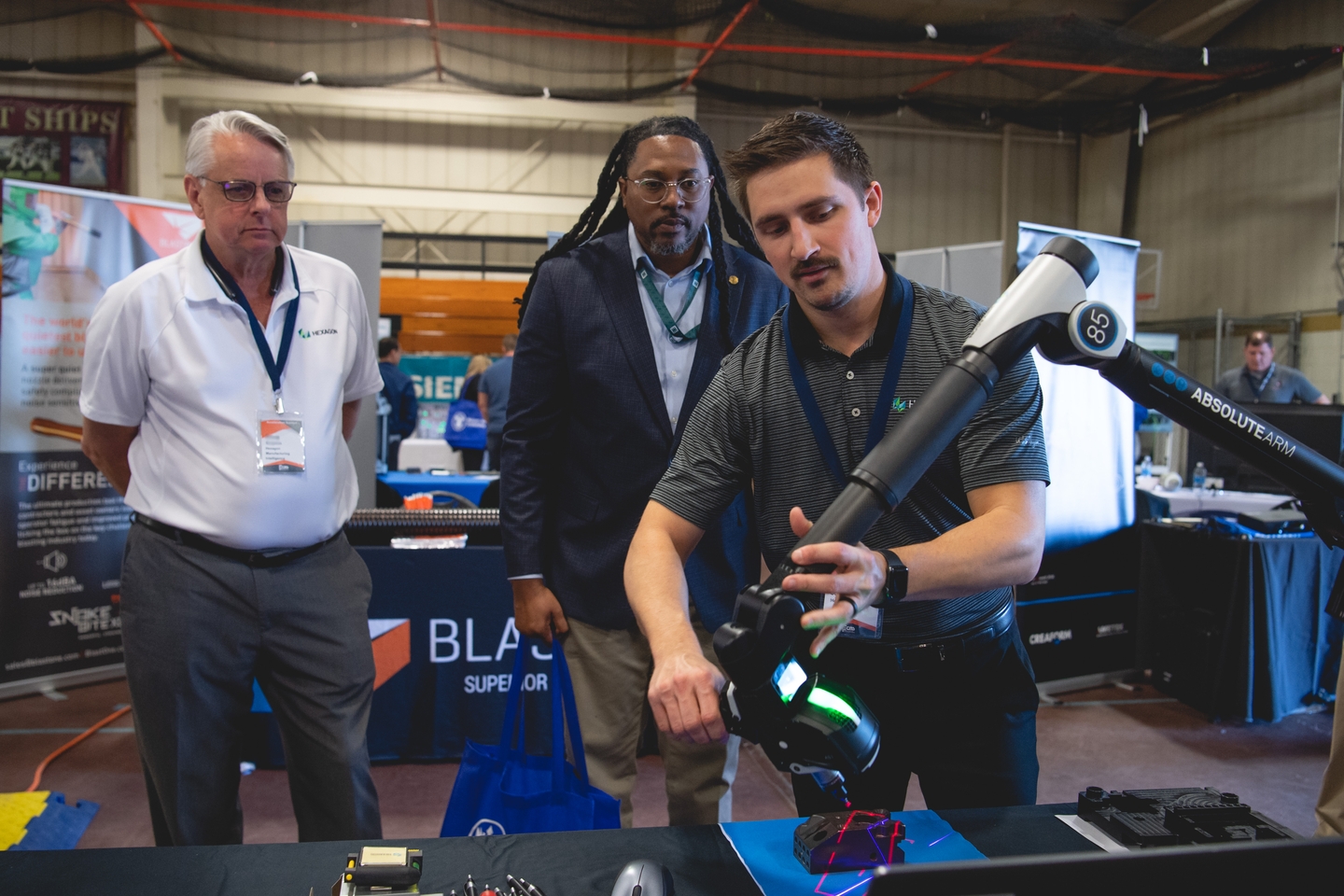
“Our #NewportNewsShipbuilding division partnered with the NCMS – National Center for Manufacturing Sciences to co-host an Acceleration Summit: Technology Showcase this week in Newport News. The event brought together industry and academic partners to share potential innovations in technology to support best practices for construction and maintenance activities in shipbuilding. Learn more about how innovation is a key enabler to our efforts here on HII.com.” |
Navy Adjusts XLUUV Program Timeline: Defense Daily reported on Tuesday that the Orca Extra Large Unmanned Undersea Vehicle (XLUUV) program has been “re-phased” and pushed back in the schedule. The fiscal year 2025 budget request documents notes that the Navy’s research and development accounts shrink on XLUUV program from $104 million in fiscal year 2024 to $21 million in 2025. During the rest of the five year Future Years Defense Program, the Navy plans to spend $41 million in fiscal year 2026 then about $13 million annually in fiscal years 2027 to 2029. Boeing is the prime contractor for Orca, working with HII.
HII’s Weekly News Digest is produced by HII’s Corporate Communications team and posted to Homeport every Friday.
Please note: Social media is blocked on HII computers for most employees. Employees are encouraged to visit HII’s Facebook page and other social media sites on personal time and from non-work devices.
Send feedback to: HII_Communications@hii-co.com.