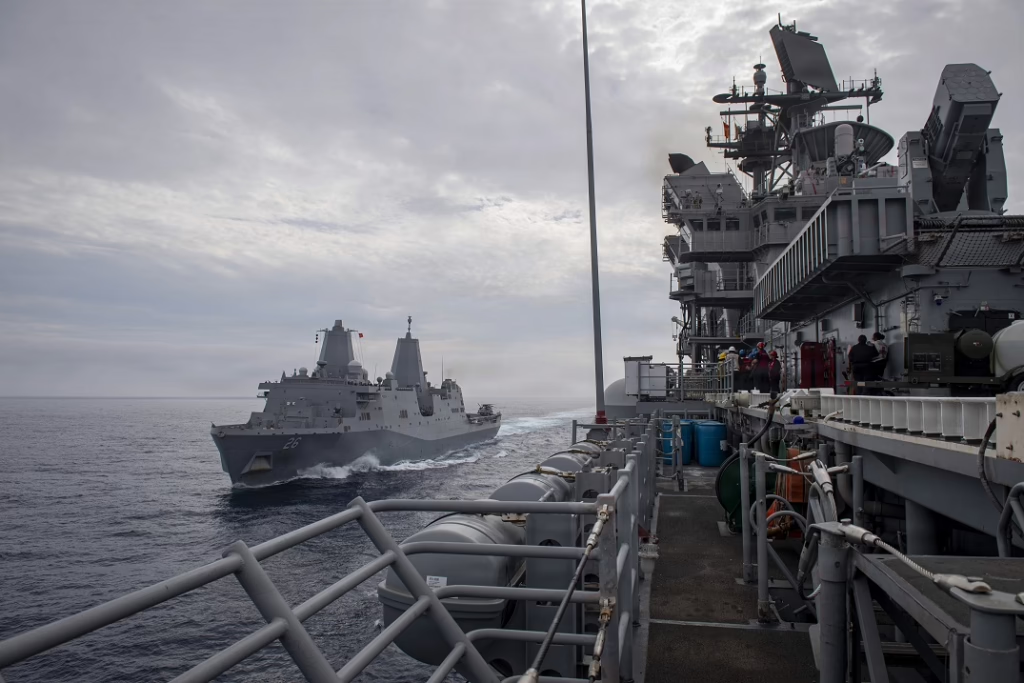

Photo caption: San Antonio-class amphibious transport dock ship USS John P. Murtha (LPD 26) comes alongside Wasp-class amphibious assault ship USS Makin Island (LHD 8) during a replenishment-at-sea, July 26, 2026. Both ships were built at HII’s Ingalls Shipbuilding division. (U.S. Navy photo by Mass Communication Specialist Seaman Eric Nelson)
Aug. 7, 2026
HII’s Weekly News Digest is compiled every Friday by the Corporate Communications team to summarize and highlight news stories of significance to the company.
HII Wins Spot On $147.9 Million Carrier Readiness Contract: Executive Biz reported Monday that HII’s Mission Technologies division secured a spot on a $147.9 million, five‑year Navy contract to support aircraft carrier readiness. The work includes hazardous waste handling, engineering services and technical support for Commander, Naval Air Forces. The deal includes a potential six‑month extension into 2032. This expands Mission Technologies’ role in sustaining Nimitz‑ and Ford‑class carriers and aligns with earlier HII contracts for carrier modernization and Nimitz‑class inactivation planning. As carrier operational tempo rises and maintenance cycles intensify, this contract strengthens HII’s enterprise presence across the carrier lifecycle.
Mission Technologies’ Unmanned Systems Portfolio Sees Strong Growth: Defense One reported July 31 that HII’s unmanned systems segment is the company’s fastest‑growing business unit. The Navy extended the Lionfish unmanned undersea vehicle contract, originally valued at nearly $350 million, and scheduled testing of the Romulus medium unmanned surface vessel for September. During the company’s second quarter earnings call, CEO Chris Kastner cited strong domestic and international pipelines, noting firm fixed‑price contracts provide solid margins. Competitors such as Anduril and Saildrone continue to invest heavily in unmanned vessels, and RIMPAC featured multiple autonomous and advanced manufacturing demonstrations. Mission Technologies is expected to grow about 5 percent in the next five years and generate up to $3.2 billion in revenue for fiscal year 2026, according to the company’s earnings update.
HII Signs Onto Partnerships To Increase Shipbuilding Throughput: Workboat reported Thursday that HII has signed seven-year, performance-based production agreements with Path Robotics and GrayMatter Robotics to develop and deploy automated manufacturing systems for U.S. Navy shipbuilding programs. HII intends to award the companies up to $900 million in shipbuilding work, contingent on their technology, manufacturing readiness and production performance. The agreements are part of HII’s High-Yield Production Robotics, or HYPR, program and cover work supporting aircraft carriers, submarines, destroyers, amphibious ships, future frigates and unmanned surface vessels. Meanwhile, Defense Daily reported Wednesday that HII is moving forward in its strategic partnership with South Korea’s HD Hyundai Heavy Industries through a pilot program that will use more intelligent mechanized welding equipment to expand automation. The pilot specifically deploys intelligent mechanized welding systems in unit‑fabrication areas that currently rely predominantly on manual welding at HII’s Ingalls Shipbuilding division. The new systems make demanding welding safer and more efficient by automatically recognizing workpieces and welding conditions, correct welding positions in real time and capture process data that can support quality control, process improvement and traceability.
Congressional Budget Office Tags First Battleship With $23.4 Billion Cost: Inside Defense reported Wednesday that the first Trump-class battleship is likely to cost $23.4 billion, according to a new Congressional Budget Office estimate. The CBO anticipates a fleet of 15 of the nuclear-powered vessels would cost approximately $275 billion in present-day dollars, or about $18 billion per vessel, over the next three decades. After the program was announced in December, the Navy tapped design agent Leidos Gibbs & Cox along with HII’s Ingalls Shipbuilding division and General Dynamics Bath Irons Works to begin developing the large surface combatant. CBO’s analysis also assumes the ships will be procured every other year as stated in the 30-year shipbuilding plan and that one shipyard, HII’s NNS division, will perform final assembly while others build sections of the vessels. The New York Times reported Thursday that President Donald Trump has said he may want to build as many as 25 nuclear-powered battleships, which he called the “golden fleet,” at a cost of roughly $455 billion, according to the figures provided in the CBO report.
Social Media Highlight Of The Week 
Posted Thursday on Mission Technologies’ LinkedIn page: “Proud to see HII’s REMUS UUVs supporting Australia Defence forces and allied nations’ counter mine operations at RIMPAC. RIMPAC demonstrates the importance of multinational collaboration and trusted autonomous systems in addressing complex maritime challenges. HII is proud to support missions that enhance maritime security, strengthen allied partnerships and help ensure freedom of navigation.” |
RIMPAC Used As Laboratory For Cutting-Edge Tech: Breaking Defense reported Monday that this year’s Rim of the Pacific exercise operated as a vast, complex test bed for advanced U.S. military technologies. Participants completed more than 35 experiments before the exercise ended last week. The event featured the largest advanced manufacturing demonstration ever conducted by the Department of War and included an armed unmanned surface vessel that launched missiles at a surface target. USNI News reported July 29 that RIMPAC demonstrations showcased shipboard 3D printing linked with autonomous drone delivery. The exercise included a historic unmanned underway replenishment when a Typhoon unmanned surface vessel autonomously entered the well deck of the amphibious assault ship USS Essex (LHD 2). Essex served as the central platform for additive manufacturing trials as the Navy and Marine Corps increasingly rely on machine‑made parts to strengthen self‑repair capabilities. RIMPAC began June 24 and took place in and around the Hawaiian Islands. The exercise involved 30 nations and included 30 surface ships, five submarines, nearly 200 aircraft and more than 30,000 personnel.
HII’s Weekly News Digest is produced by HII’s Corporate Communications team and posted to MyHII every Friday.
Please note: Social media is blocked on HII computers for most employees. Employees are encouraged to visit HII’s Facebook page and other social media sites on personal time and from non-work devices.
Send feedback to: HII_Communications@hii-co.com.