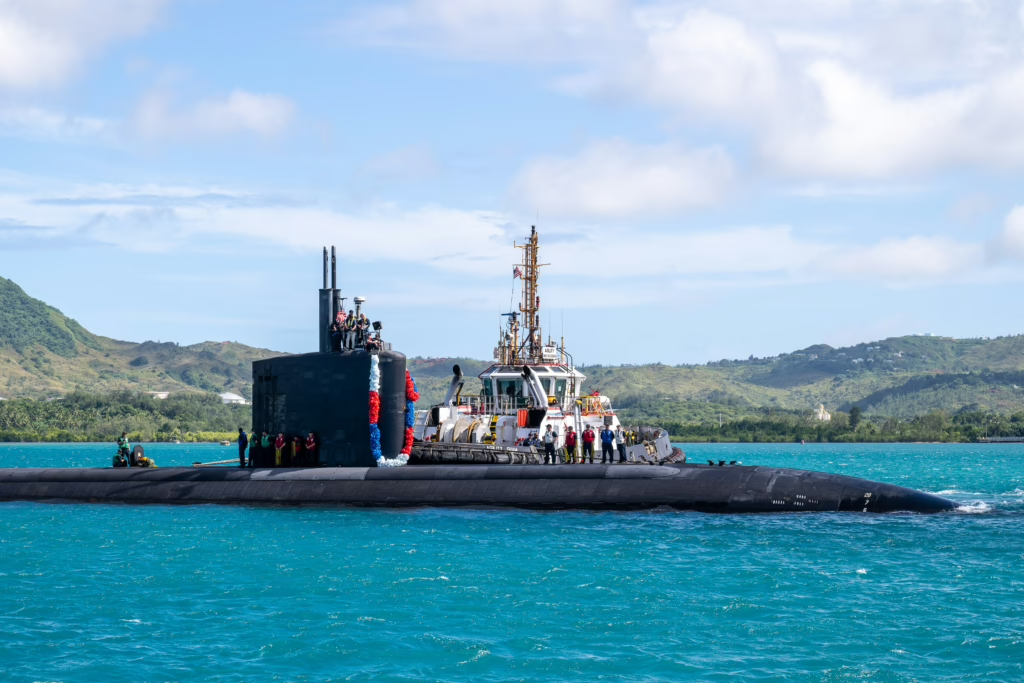

Photo caption: Los Angeles-class fast-attack submarine USS Asheville (SSN 758) returns to Naval Base Guam, reaffirming its role in the Indo-Pacific, Nov. 18, 2025. US Ashville was built at HII’s Newport News Shipbuilding division and commissioned by the U.S. Navy in 1991. (U.S. Navy photo by Mass Communication Specialist 1st Class Bryan Mai)
Nov. 21, 2025
HII’s Weekly News Digest is compiled every Friday by the Corporate Communications team to summarize and highlight news stories of significance to the company.
Navy Advances Columbia-class Submarine Program With $2.28 Billion Contract: The Defense Post reported on Tuesday that the Defense Department awarded General Dynamics Electric Boat a $2.28 billion contract to support assembly of Columbia-class submarine hulls SSBN 828 through SSBN 832. Work will be performed primarily at Electric Boat’s Groton, Connecticut, shipyard, with supporting production in Virginia and Rhode Island. The Navy plans to build a total of 12 Columbia-class submarines to replace the aging Ohio-class fleet, which is nearing the end of its 42-year service life. The lead ship, District of Columbia (SSBN 826), is expected to enter service in 2031, with Wisconsin (SSBN 827) slated for commissioning the same year. USNI News reported on Thursday that the bow of District of Columbia left HII’s Newport News Shipbuilding division this week and is en route to General Dynamics Electric Boat, where the submarine will be assembled and tested. Columbia-class submarines are built in modular sections between EB’s yard in Groton, Conn., and HII’s Newport News Shipbuilding in Virginia. EB builds the central barrel of the boats, while NNS builds the bows and sterns. Subcontractor Northrop Grumman builds the steam turbines. EB is responsible for the final assembly of the submarines at a custom-built building in Groton. Interesting Engineering reported on Wednesday that Navy budget documents now estimate total program costs at $126.4 billion, reflecting rising industrial and workforce demands.
Two Virginia-Class Submarines Conduct Rare Simultaneous Sea Trials: Naval News reported on Friday, Nov. 14, that the U.S. Navy conducted rare concurrent sea trials for the future Idaho (SSN 799) and Massachusetts (SSN 798), signaling increased production and testing tempo in the attack submarine fleet. HII announced on Friday, Nov. 21, that it has delivered Massachusetts to the U.S. Navy. Both submarines are scheduled to enter service in 2026, with commissioning dates still pending. The boats were recently observed returning to port, with Massachusetts entering Naval Station Norfolk and Idaho returning to Electric Boat’s Groton, Connecticut, facilities. The submarines are Block IV Virginia-class boats, designed to reduce maintenance periods and increase operational availability. Block IV upgrades include improved sonar and expanded vertical launch capacity for Tomahawk missiles. The Navy plans to field 10 Block IV submarines as part of its undersea modernization strategy. Future Block V boats are expected to further expand strike capacity through the Virginia Payload Module (VPM).
Pensacola Solicits Shipbuilding Companies For New Port Facility: Dredgewire reported on Wednesday that the city of Pensacola, Florida, is recruiting a military shipbuilder to operate a facility at its port that would be capable of producing complex Navy ship modules for Tier 1 shipyards, submarine modules, and complete surface ships up to 400 feet in length. The Pensacola News Journal reported on Monday that, if approved, the project would create close to 2,000 jobs. Before that happens, the city of Pensacola is asking the economic development nonprofit Triumph Gulf Coast to back an $86 million grant as part of the $250 million project to build and outfit the 400,000-square-foot shipbuilding facility at the Port of Pensacola. While city officials have declined to name the shipbuilder being targeted for the project, details in the grant application point to Austrian company, Birdon, as the likely target. The company has done work for the U.S. Army, Coast Guard, Navy and Marines, as well as civilian customers.
| Social Media Highlight Of The Week
Posted Monday on HII’s Facebook page:  “A titan, indeed. Nimitz-class aircraft carrier USS George H.W. Bush (CVN 77), built by our #NewportNewsShipbuilding division, transits the Atlantic Ocean in support of the Titans of the Sea Presidential Review, one of many events to showcase American maritime power as part of the U.S. Navy’s 250th birthday celebration. The U.S. Navy has defended our freedoms from sea to shore for two and a half centuries. HII has been advancing U.S. national defense for nearly 140 years, and we’ll ensure our Navy remains mission-ready for generations to come. #AircraftCarrierMonth #AmericasNavy250 📸: U.S. Navy/MC2 Rosales” |
Adm. Daryl Caudle Tours South Korean Shipyards: USNI News reported on Tuesday that Chief of Naval Operations Adm. Daryl Caudle toured two South Korean shipyards last week to observe best practices as part of his 10-day tour of South Korea, Japan, Guam and Hawaii. Caudle visited HD Hyundai Heavy Industries in Ulsan and Hanwha Ocean in Geoje to gain insights into South Korea’s shipbuilding industry and practices that the U.S. shipbuilding industry could adopt. Caudle said he hopes the visits will yield lessons the U.S. shipbuilding industry could learn from, specifically on how South Korea manages its shipbuilding labor force and meets construction schedules and deadlines. Stars and Stripes reported on Monday that Caudle also answered a wide range of questions from reporters during the trip. He described South Korea’s approval to build a nuclear-powered submarine as “extremely nascent,” and he hopes to bridge the gap between Chinese and American shipbuilding capacity by forging partnerships with Japan and South Korea.
Pentagon Finalizes Golden Dome Architecture: Inside Defense reported on Wednesday that the Pentagon has completed the baseline architecture for the Golden Dome for America initiative and is shifting its focus to reviewing an implementation plan. Deputy Defense Secretary Steve Feinberg recently approved the architecture, clearing the way for the program office to begin mapping out how the system will be built and deployed. Golden Dome carries a projected price tag of $175 billion and a goal of fielding an initial capability within three years. Breaking Defense reported Thursday that members of the House Armed Services Committee could be briefed on the project as early as this week. Congress has already begun seeding the effort with significant funding. The recently enacted One Big Beautiful Bill Act included $25 billion that Congress intended for the project in fiscal year 2026, including $5.6 billion for space-based interceptors, giving the department resources to begin moving quickly once industry proposals are evaluated and contracts awarded.
HII’s Weekly News Digest is produced by HII’s Corporate Communications team and posted to Homeport every Friday.
Please note: Social media is blocked on HII computers for most employees. Employees are encouraged to visit HII’s Facebook page and other social media sites on personal time and from non-work devices.
Send feedback to: HII_Communications@hii-co.com.