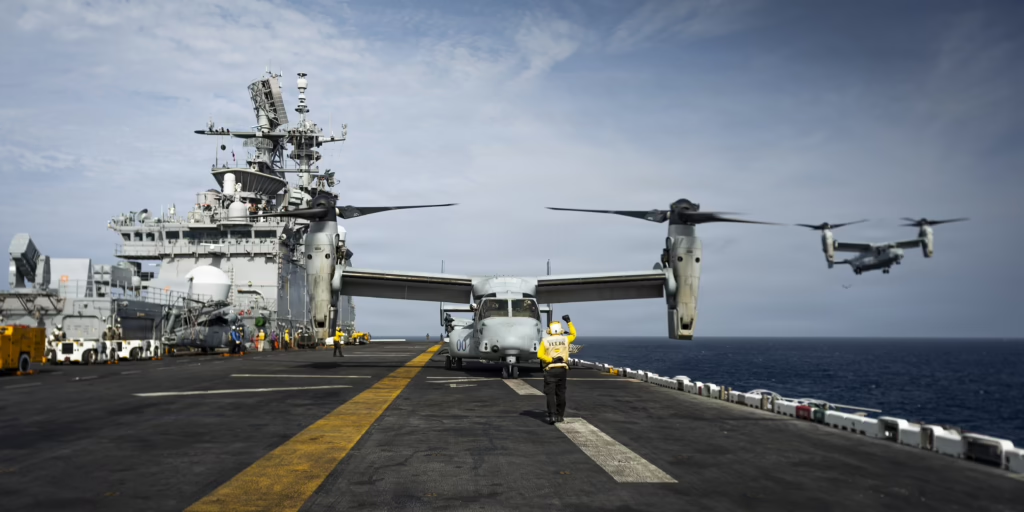

Photo caption: An MV-22B Osprey tiltrotor aircraft approaches the flight deck of Wasp-class amphibious assault ship USS Iwo Jima (LHD 7), during a visit with Gen. Francis L. Donovan, commander, U.S. Southern Command, while underway in the Caribbean Sea, May 23, 2026. 2026. Iwo Jima was built by HII’s Ingalls Shipbuilding division. (U.S. Navy photo)
May 29, 2026
HII’s Weekly News Digest is compiled every Friday by the Corporate Communications team to summarize and highlight news stories of significance to the company.
House Unveils $1.14 Trillion Defense Bill: The Washington Post reported on Tuesday that the House Armed Services Committee has introduced a $1.14 trillion version of the National Defense Authorization Act for the coming 2027 fiscal year. The bill “primarily aims to boost the U.S. defense industry and is consistent with President Donald Trump’s call for defense spending growth. USNI News reported on Tuesday that the bill authorizes $500 million in incremental funding for the Navy to buy a second Flight III Arleigh Burke-class destroyer, which would likely be awarded to General Dynamics Bath Iron Works. Despite the spending growth, House appropriators did include some hurdles. Inside Defense reported on Tuesday that language within the House bill would prohibit a production contract award for the Trump-class battleship program until the Navy certifies the ship’s weapon systems to be sufficiently mature. An eventual $350 billion reconciliation bill will also be required to bridge the gap between the president’s call for $1.5 trillion in defense spending and the House version of the defense bill. Defense One reported on Wednesday that the Pentagon’s $350 billion reconciliation funding request includes $47 billion to “accelerate the delivery and drive” of munitions investment, roughly $17 billion for Golden Dome, and $7 billion for shipbuilding efforts. Defense Daily reported on Tuesday that the defense spending boost represents a 42% increase from the FY 2026 enacted level of just over $1 trillion when accounting for both the final defense appropriations legislation and the $150 billion in reconciliation funds included for defense in last year’s One Big Beautiful Bill Act. The House Armed Services Committee is scheduled to meet on June 4 to mark up its bill. Politico reported on Thursday that the Senate Armed Services Committee plans to consider its version of the NDAA the week of June 8.
HII Targets Distributed Shipbuilding Growth: Inside Defense reported on Thursday that HII aims to further increase production outsourcing by 30% in 2026 as it adjusts to meet the Navy’s rapidly growing demand. CEO Chris Kastner told participants at the Bernstein Strategic Decisions conference that the company is working with partners to help facilitate its own outsourcing efforts. “So we go to partners, we do initial pilot programs with them. They’ll build one or two units; we make sure they have sufficient capital and labor and the technical know-how to execute on it. Once they do that, we’ll expand their scope and grow,” he said. During the event, Kastner also reiterated that he expects a long-delayed contract award for block VI Virginia-class submarines to be completed within the second quarter of the company’s fiscal year 2026, meaning the award could be finalized by the end of June.
Navy Narrows MUSV Program To Seven Designs: USNI News reported on Friday, May 22, that the U.S. Navy has selected seven designs submitted for the service’s medium unmanned surface vessel program. Without naming the companies it has selected, the Navy is now asking those shipbuilders to develop vessels that will be tested against Navy requirements for the robotic craft. The basic requirements include the vessel having the ability to travel 2,500 nautical miles at 25 knots in sea state 4 carrying a payload of up to 25 metric tons, according to naval solicitation documents published in late March. The payload needs to accommodate at least two 40-foot shipping containers and operate autonomously with the shipbuilder able to field an operational vessel by fiscal year 2027. Shipbuilders able to meet the requirements during the prototype phase will receive $15 million and be eligible for follow-on production, according to the solicitation. Defense Daily has previously reported that HII is building its ROMULUS modular AI-enabled family of USVs that utilize its Odyssey Autonomous Control System (ACS) software suite. Specifically, the ROMULUS 190 is built on a commercial-standard hull, engineered for quick repeatable production, designed for speeds over 25 knots, has a minimum range of 2,500 nautical miles and can carry four 40-foot ISO intermodal containers on the payload deck. HII is developing it via a partnership with Breaux Brothers, Beier Integrated Systems, and Incat Crowther.
| Social Media Highlight Of The Week
Posted Thursday on Ingalls’ LinkedIn page: “The future USS Bougainville (LHA 8) continues advancing through major mechanical system updates, with the aircraft elevator (ACE) chain now loaded and secured. The ACE will play a critical role once the ship is handed over, supporting amphibious and aviation missions. Way to go, shipbuilders on the incredible teamwork!” |
Navy To Homeport SSBNs At Naval Base Kitsap: Stars and Stripes reported on Wednesday that the Navy plans to homeport as many as eight Columbia-class ballistic missile submarines at Naval Base Kitsap-Bangor by early in the next decade. The submarines would replace up to eight of the current Ohio-class submarines homeported at the base just west of Seattle on the Puget Sound. The first Columbia-class boat, District of Columbia (SSBN 826), is under construction at General Dynamics Electric Boat in Groton, Conn. Modules for follow-on boats in the class are being built at Electric Boat’s Quonset Point facility and HII’s Newport News Shipbuilding. Construction needed at Naval Base Kitsap-Bangor for the Columbia-class boats would begin in July 2027. The first submarine would be expected to arrive for homeporting in 2032. The Navy also plans to homeport some of the Columbia-class submarines at Kings Bay, Georgia.
NRC Accelerating Small Modular Reactor Licensing: Reuters reported on Tuesday that the U.S. Nuclear Regulatory Commission is rolling out a suite of reforms to expedite the approval of small modular reactor designs. Three major regulations are being fast tracked to comply with a May 2025 executive order that mandate the NRC approve new reactor designs within 18 months. The order is part of the Trump administration’s efforts to boost domestic nuclear capacity from around 100 gigawatts today to 400 gigawatts by 2050 to meet surging demand for energy. The NRC proposed a rule on April 2 to create an expedited pathway for the approval of reactor designs that have been tested and proven safe under the Department of Energy and Department of Defense pilot reactor programs. The 10 companies selected for DOE’s Reactor Pilot Program last year are set to benefit from this proposed rule. The program seeks to ensure that at least three reactors achieve criticality, the point of a self-sustaining chain reaction, by July 4 this year. Several companies in the federal reactor pilot programs are developing microreactors, which typically feature capacities of between 1 megawatt and 20 megawatts. They are designed to operate for years without refueling, often servicing remote locations or military bases. The use cases for small modular reactors are growing. Forbes reported on Saturday that the U.S. Maritime Administration, under the U.S. Department of Transportation, is collaborating with the U.S. Coast Guard, the NRC and the DOE to develop small modular reactors. The administration is open to projects for a single vessel or technologies that demonstrate system architecture (including liability frameworks, insurance pathways, port acceptance, workforce development) and how small modular reactors can be integrated with deploying ships.
HII’s Weekly News Digest is produced by HII’s Corporate Communications team and posted to Homeport every Friday.
Please note: Social media is blocked on HII computers for most employees. Employees are encouraged to visit HII’s Facebook page and other social media sites on personal time and from non-work devices.
Send feedback to: HII_Communications@hii-co.com.