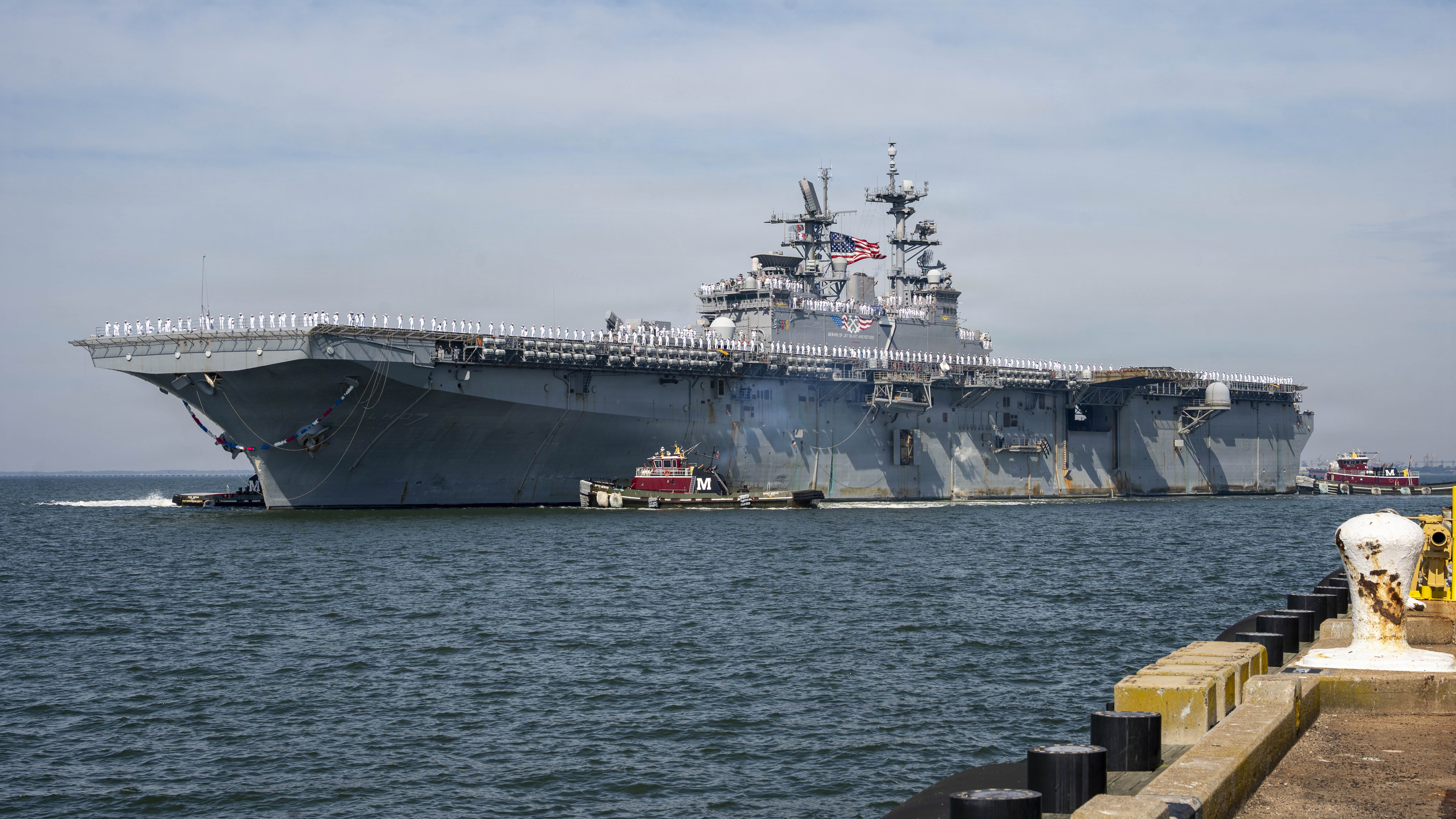

Photo caption: NORFOLK, VA. (June 6, 2026) Wasp-class amphibious assault ship USS Iwo Jima (LHD 7) returns to Naval Station Norfolk following a 10-month deployment as part of the Iwo Jima Amphibious Ready Group (IWO ARG). Iwo Jima, the flagship of the IWO ARG, was built by HII’s Ingalls Shipbuilding division. (U.S. Navy photo by Mass Communication Specialist 3rd Class Greggory Fisher)
June 5, 2026
HII’s Weekly News Digest is compiled every Friday by the Corporate Communications team to summarize and highlight news stories of significance to the company.
U.S. Navy Selects 7 Contenders For The MUSV Program: Naval News reported on Monday that The U.S. Navy has selected seven companies for at‑sea prototype testing under the Medium Unmanned Surface Vessel (MUSV) Family of Systems marketplace program. The selectees — Sea Machines, Leidos, Saronic Technologies, Galliano Marine Services, PacMar Technologies, Birdon, and HII — were chosen from more than two dozen applicants. Each company will receive $15 million to support testing from June through October 2026, after which successful designs may move into production or leasing arrangements.
The MUSV program seeks to rapidly assess industry‑provided unmanned surface vessel designs capable of meeting common performance requirements: 2,500‑nautical‑mile range, a 25‑metric‑ton payload, operations in Sea State 4, speeds of 25 knots, and at least partial autonomous operation. The Navy intends to use modular, containerized payloads for missions such as strike, intelligence/surveillance/reconnaissance, and logistics.
Meantime Defense Daily reported Wednesday that this year’s competition is limited to the current seven prototypes, but the Navy emphasized the marketplace model is intentionally flexible. If the fleet identifies new mission needs or different MUSV requirements, the marketplace could re-open, allowing both previous applicants and new entrants to compete with alternate designs. The Navy may also revisit the marketplace if none of the current prototypes perform satisfactorily in at‑sea trials.
The marketplace represents a shift in acquisition strategy, offloading early research, development, and production risk to industry by requiring companies to bring forward mature designs rather than rely on Navy‑built prototypes. This approach is being advanced by Rebecca Gassler, Portfolio Acquisition Executive for Robotic and Autonomous Systems (PAE RAS), who is also hosting an industry day on June 10–11 in San Diego to align industry, academia, and investors with the Navy’s unmanned systems roadmap.
Significant funding reflects the Navy’s push for unmanned systems mass. The service has allocated $1.95 billion in FY26 and plans another $3 billion over five years, enabling the procurement of 81 MUSVs by FY2031, including 36 platforms funded in FY26 alone.
House Democrats Fail To Eliminate Battleship Funding: House authorizers are pressing the Navy to assess how pursuing the nuclear-powered Trump‑class battleship, or BBG(X), would affect the nation’s already strained nuclear shipbuilding and reactor industrial base. According to Inside Defense, during the House Armed Services Committee (HASC) markup of the fiscal year 2027 defense authorization bill, Rep. Joe Courtney, D-Conn., offered an amendment requiring a March 2027 report from the Secretary of the Navy and the head of Naval Nuclear Propulsion. The report must detail acquisition plans for the battleship, its nuclear reactor needs, and steps to avoid further delays to Ford‑class aircraft carriers, which are built at HII’s Newport News Shipbuilding (NNS).
The committee emphasized that only two U.S. shipyards can build nuclear-powered vessels — NNS and General Dynamics Electric Boat — and that NNS is already facing significant delays on every Ford‑class carrier. Navy officials have stated that BBG(X) final assembly would occur at Dry Dock 12 in Newport News, the same facility used for Ford‑class construction, and that the battleship would rely on the same A1B reactors. With BWX Technologies serving as the Navy’s sole reactor supplier, lawmakers warned that an accelerated battleship timeline could strain the supply chain and jeopardize carrier delivery schedules.
The future Doris Miller (CVN 81) is already delayed two years, and Enterprise (CVN 80) is eight months behind. Courtney’s amendment would require the Navy to assess nuclear‑capable shipyard capacity, reactor production timelines, and the broader industrial base—including impacts on the Clinton (CVN 82) and George Bush (CVN 83) carriers.
Separately, USNI News reported that democrats attempted but failed — on a 30‑26 party‑line vote — to remove $1 billion in advance procurement for the battleship. Ranking Member Adam Smith, D-Wash., argued that the Navy is ordering materials before completing any ship design work, calling it inconsistent with past lessons from failed or troubled programs like Zumwalt, LCS, and CG(X). Chairman Mike Rogers, R-Ala., defended the program, asserting a longstanding Navy need for a large surface combatant and warning that canceling early funding would stall design progress.
Additional amendments would require the Navy and the Government Accountability Office to examine BBG(X)’s business case, design maturity, operational concepts, and risks — while also reviewing Ford‑class cost and schedule drivers. The Senate’s companion NDAA draft has not yet been released.
Social Media Highlight Of The Week 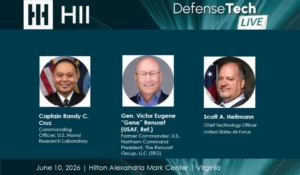
Posted Friday on Mission Technologies’ LinkedIn page: “Three leaders. Three perspectives. One conversation on the future of defense. At DefenseTech LIVE 2026, military leaders from across the services will discuss the challenges shaping today’s operational environment, from defense acquisition and modernization to integrated deterrence and mission readiness. Featured speakers include: • Capt. RANDY CRUZ (US Navy) • Gen. Victor “Gene” Renuart (United States Air Force, Ret.) • Scott Heitmann (United States Air Force) Join government and industry leaders on June 10 as they share insights on delivering speed, resilience, and capability across the force. Government and military registration is complimentary. See the full list of speakers and register here: https://www.hii.com/events/defensetechlive2026” |
A Navy Carrier Is About To Deploy With A Robot Ship. Could It Change The Service Forever?: The aircraft carrier Theodore Roosevelt will soon deploy with a Seahawk medium unmanned surface vessel (MUSV) for the first time, marking the Navy’s shift from experimental to operational use of unmanned ships. Experts say the deployment could shape how the service develops both its concept of operations (CONOPS) and its acquisition strategy for autonomous vessels.
Breaking Defense reports that the Seahawk, derived from DARPA’s Sea Hunter program, has previously operated in smaller unmanned-focused events, but embedding it in a full carrier strike group signals that the Navy now sees MUSVs as contributors to real missions such as intelligence, surveillance, reconnaissance, electronic warfare, and potentially countermine operations.
The deployment comes as the Navy grapples with force‑structure strain, extended carrier missions, and uncertainty over how to integrate unmanned systems across domains. Chief of Naval Operations Adm. Daryl Caudle has emphasized the need for a “hedge force strategy” using unmanned platforms and is considering new organizational structures, such as a dedicated RAS (robotic autonomous systems) commander or warfighting center.
Lessons from the Seahawk’s deployment — including endurance, refueling, command‑and‑control needs, and how well it keeps pace with carrier operations — are expected to inform both future CONOPS and what the Navy buys next. This will feed into the service’s new marketplace‑based acquisition approach for medium USVs, which seeks faster, more flexible procurement.
While unmanned systems won’t accompany every deployment immediately, analysts expect the Roosevelt mission to become a model for routine integration in the future.
Seismic Upgrade At Puget Sound: Stars and Stripes reported this week that the Navy completed seismic anchoring work on Dry Dock 4 at Puget Sound Naval Shipyard five months early, creating time within the existing $377.7 million contract to add further earthquake‑resilience upgrades. The expanded work will include soil improvements, structural enhancements to the pump well, and added anchors, all performed by the same contractor team. The upgrades follow 2023 seismic assessments that prompted temporary closures of several dry docks in the region, including facilities supporting ballistic missile submarines.
Dry Dock 4, built in 1942 and historically used to repair World War II battle‑damaged ships, is being reinforced due to growing awareness of the risks posed by the Cascadia Subduction Zone. Scientists estimate the region faces a significant chance of a major earthquake in the coming decades, with
potential shaking and tsunami impacts. The project is part of the Navy’s long‑term Shipyard Infrastructure Optimization Program, a 20‑year, $20‑billion effort to modernize all four public shipyards. NAVFAC Northwest said the early completion will allow additional mitigation work that will save time and money for the fleet.
HII’s Weekly News Digest is produced by HII’s Corporate Communications team and posted to Homeport every Friday.
Please note: Social media is blocked on HII computers for most employees. Employees are encouraged to visit HII’s Facebook page and other social media sites on personal time and from non-work devices.
Send feedback to: HII_Communications@hii-co.com.