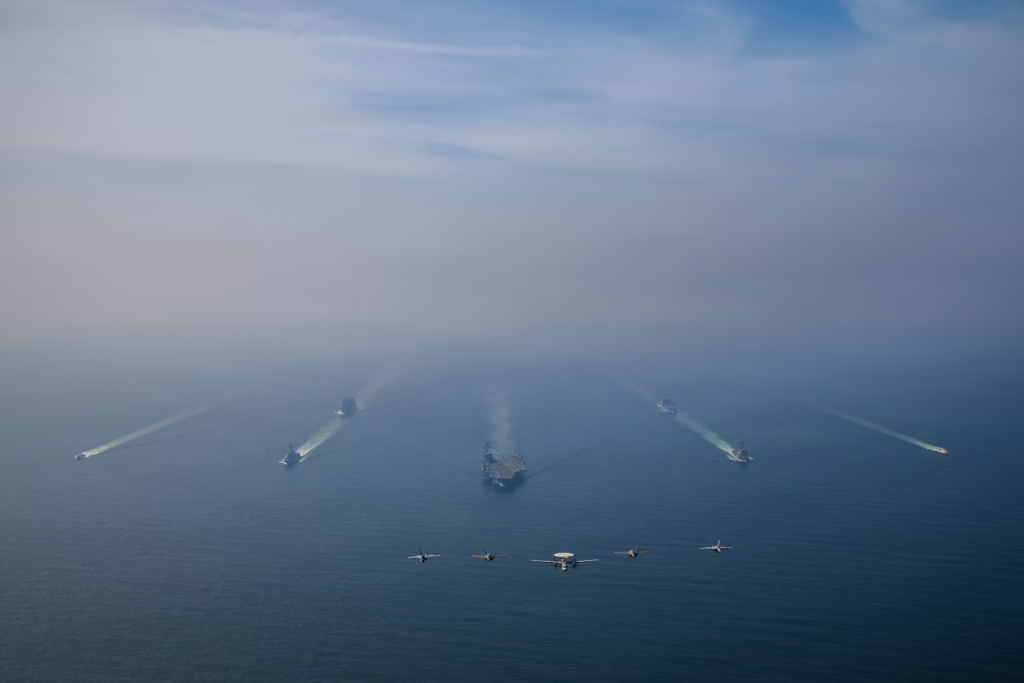

Photo caption: Nimitz-class aircraft carrier USS Abraham Lincoln (CVN 72), Arleigh Burke-class guided-missile destroyers USS Michael Murphy (DDG 112) and USS Frank E. Petersen Jr. (DDG 121), Henry J. Kaiser-class fleet replenishment oiler USNS Henry J. Kaiser (T-AO-187), Lewis and Clark-class dry cargo ship USNS Carl Brashear (T-AKE 7) and U.S. Coast Guard Sentinel-class fast-response cutters USCG Robert Goldman (WPC-1142) and USCGC Clarence Sutphin. Jr. (WPC-1147) sail in formation in the Arabian Sea while aircraft, from Carrier Air Wing 9, fly overhead, Feb. 6, 2026. (U.S. Navy photo by Mass Communication Specialist 1st Class Jesse Monford)
Feb. 13, 2026
HII’s Weekly News Digest is compiled every Friday by the Corporate Communications team to summarize and highlight news stories of significance to the company.
Hegseth: Fiscal Year ’27 Budget Will Invest Heavily In Destroyers: Defense Daily reported on Monday that the Pentagon’s upcoming fiscal year 2027 budget request includes strong investments in guided missile destroyers. Defense Secretary Pete Hegseth told an audience on Monday at his Arsenal of Freedom tour stop at Bath Iron Works that the budget request is “maxing out” its investments in DDGs. Hegseth offered the budget request preview as President Donald Trump has called for increasing the defense topline to $1.5 trillion in 2027. Both Bath Iron Works and HII’s Ingalls Shipbuilding division build Arleigh Burke-class guided missile destroyers. The final fiscal year 2026 defense appropriations bill, signed into law last week, included $1.75 billion for advancement procurement of Arleigh Burke-class destroyers, which followed last year’s reconciliation bill covering $5.4 billion for DDG 51 procurement. Bangor Daily News reported on Monday that Hegseth enticed the crowd of shipbuilders to work quickly. “If you build the best, at fastest, at cost, on behalf of taxpayers, you will win,” he said.
Zumwalt Emerges As Technology Testbed For Battleship: Defense Daily reported on Tuesday that Zumwalt-class destroyers may become a testbed for the future Trump-class battleship’s weapons. Vice Adm. Brandan McLane, commander of Naval Surface Forces, suggested the three-ship fleet of Zumwalt-class destroyers can be used as a test platform. McLane called the Zumwalt class the closest thing the Navy has to a battleship, so he argued investing in testing more weapons on it will be an important part of innovating for the battleship and future fleet forces. In January’s HII’s Ingalls Shipbuilding division completed the USS Zumwalt (DDG-1000) builder’s sea trials after it replaced the ship’s two unused 155mm Advanced Gun Systems with four 87-inch vertical launch system tubes that will eventually field up to 12 Conventional Prompt Strike missiles. Meanwhile, Breaking Defense reported on Wednesday that McLane told participants at the WEST 2026 conference in San Diego that the Trump-class battleships are needed because of limitations in the service’s existing platforms. Specifically, the Navy’s destroyers could be up-gunned to an extent before backing concessions with removing other capabilities on the platform. Construction for the battleships is expected to kick off in the early 2030s, and the vessels will replace the Navy’s plans for the DDG(X) program.
Navy Moves Toward Tailored Carrier Strike Group Model: Breaking Defense reported on Tuesday that the Navy is moving to reshape the traditional carrier strike group model through a new tailored force concept. The approach is outlined in the Chief of Naval Operations Adm. Daryl Caudle’s Fighting Instructions, which describe how the service plans to organize, train and deploy forces. The Navy wants to give combatant commanders scalable force packages instead of relying on fixed strike group formations. Caudle said the goal is to move beyond an “all or nothing” model and provide commanders the right amount of naval power for specific missions. Leaders said the shift is intended to improve flexibility and better align capacity to operational demands. The guidance builds on recent operations in the Red Sea and eastern Mediterranean where destroyers were reassigned between strike groups to meet demand. It also emphasizes expanded use of unmanned surface and undersea systems and smaller formations for missions that do not require a full carrier presence.
| Social Media Highlight Of The Week
Posted Friday on HII’s LinkedIn page:
“As we wrap up our time at #WEST2026 in San Diego, Calif., here’s a recap of what happened on Day 2. VADM Tom Moore, USN (Ret.), HII’s senior vice president of government relations, joined the Building the Fleet to Meet the Mission Panel on Wednesday. This session focused on how building lead capable of meeting today’s operational demands in tomorrow’s contest in maritime environment requires a resilient industrial base and agile, workforce and sustain partnership between government industry, and Congress. The panel of experts examined the full ecosystem required to deliver the ships and submarines the nation needs. The conversation provided a candid look at the challenges, opportunities, and priorities shaping the future fleet, and what it will take to build and sustain it. We thank AFCEA International for hosting us and all attendees who stopped by the HII booth to learn how we’re building and delivering capability, speed, and advantage to the fleet. #AFCEAWest #WEST2026 #DeliveringTheAdvantage” |
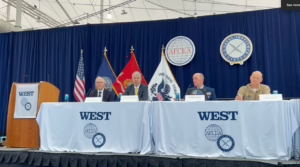
Lead Columbia-Class Submarine Construction Schedule Improves: USNI News reported on Wednesday that shipbuilders at HII’s Newport News Shipbuilding division and General Dynamic Electric Boat are now working toward delivering ballistic missile submarine District of Columbia (SSBN 826) in 2028. Program Executive Officer Strategic Submarines Rear Adm. Todd Weeks said Wednesday at a panel during WEST 2026 that he expects the boat will reach its pressure hull complete milestone and be launched before the end of the calendar year. Delivery of the first-in-class boat had most recently been estimated for 2029. Inside Defense reported on Wednesday that Weeks said District of Columbia is now about 65% complete. HII delivered the bow section of the boat to Electric Boat in November. Shipbuilders are also making significant progress on the second boat in the class, Wisconsin (SSBN 827), which is about 35% complete, Weeks said. Looking ahead, the program of a dozen boomers is set to hit full serial production by 2031.
Navy Eyes Expanded San Diego Shipyard Capacity: The San Diego Union-Tribune reported on Tuesday that the Navy is assessing whether San Diego shipyards can expand maintenance and repair capacity to support fleet readiness. Chief of Naval Operations Adm. Daryl Caudle said the service is seeking additional throughput to sustain operations in the Indo-Pacific and Middle East and reduce strain from extended deployments. He emphasized that longer deployments are affecting sailors, ships and maintenance cycles, particularly among West Coast carrier strike groups. Caudle called for growth toward a roughly 381-ship fleet, noting the Navy currently fields fewer than 300 deployable manned ships. He said unmanned surface vessels will supplement the fleet but will not replace aircraft carriers, which he described as the Navy’s primary source of combat power. The Navy is expected to engage industry on options to increase yard capacity, with San Diego yards performing a significant share of West Coast repair work.
HII’s Weekly News Digest is produced by HII’s Corporate Communications team and posted to Homeport every Friday.
Please note: Social media is blocked on HII computers for most employees. Employees are encouraged to visit HII’s Facebook page and other social media sites on personal time and from non-work devices.
Send feedback to: HII_Communications@hii-co.com.