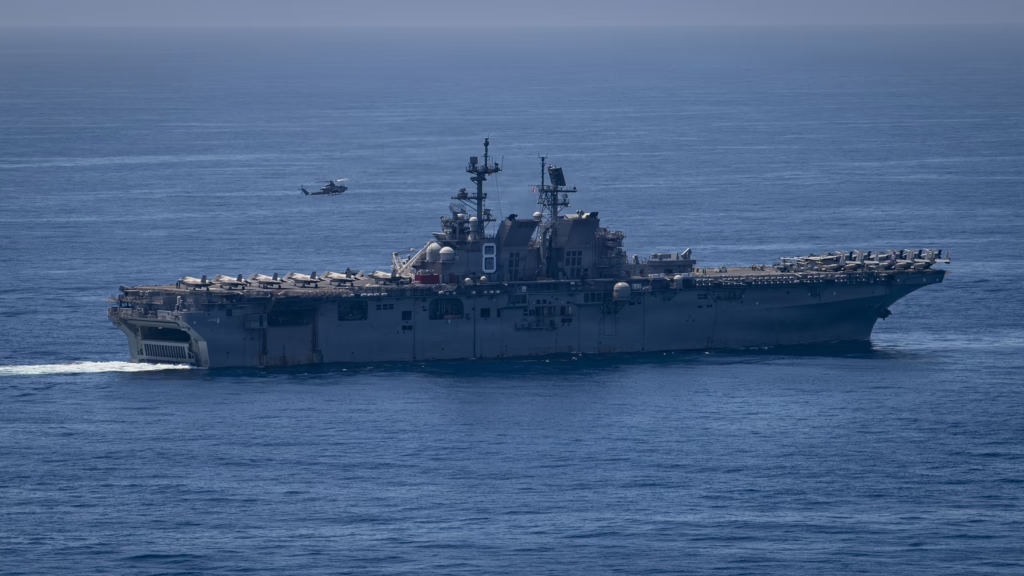

Photo caption: Photo caption: Wasp-class amphibious assault ship USS Makin Island (LHD 8) transits the Pacific Ocean, Aug. 21, 2026. The Makin Island Amphibious Ready Group and the 13th Marine Expeditionary Unit are currently underway conducting routine operations in the U.S. 3rd Fleet area of operations to enhance their combined Navy-Marine Corps readiness and lethality. (U.S. Navy photo by Mass Communication Specialist Seaman Eric Nelson)
You can now also find the Weekly News Digest on SharePoint.
Aug. 28, 2026
HII’s Weekly News Digest is compiled every Friday by the Corporate Communications team to summarize and highlight news stories of significance to the company.
Ford-Class Sortie Rate Eclipses Predecessors: USNI News reported on Monday that USS Gerald R. Ford (CVN 78) outperformed legacy Nimitz-class aircraft carriers in a test of the carrier’s launch and recovery systems. The Navy put Ford’s electromagnetic launch system (EMALS) and the advanced arresting gear under a four-day stress test in February while the carrier was in the Caribbean Sea, Chief of Naval Operations Adm. Daryl Caudle told participants at the Tailhook Symposium in Reno, Nevada. During the test, Ford’s sortie generation rate was 120% to 130% of that produced by Nimitz-class carriers. “It’s not just the catapults and the arresting gear. It’s all the technologies, the whole system,” Caudle said. “That’s due to the entire set of things that were done on Ford to make it better.” The Ford-class was designed to generate more aircraft launches with fewer sailors than the previous generation of carriers by including technologies like EMALS, the (advanced arresting gear) and positioning systems like weapons elevators and fuel hoses to maximize efficiency and speed. News of Ford’s performance comes after the president signed a national security memo on Aug. 13 that would end the use of EMALS in future Ford-class carriers, starting with CVN 81.
Halimar Advances HII’s ROMULUS Construction: Ocean News & Technology reported on Tuesday that Halimar Shipyard is advancing construction of HII’s ROMULUS 151 unmanned surface vessels (USVs). The relationship further strengthens HII’s strategy to expand production capacity through a distributed manufacturing network of experienced U.S. shipbuilders. As part of the ROMULUS 151 network, HII works closely with Halimar, Breaux Brothers, and key manufacturing partner Bayou Metal Supply & Manufacturing in Slidell, Louisiana. Bayou Metal has established a dedicated production line for precision cutting, bending, welding and assembly of major structural components for the ROMULUS USV, accelerating build schedules. This distributed shipbuilding approach increases throughput and enables faster, more consistent serial production of ROMULUS vessels. HII’s continued investment in the Gulf Coast’s maritime industrial base is increasing national production capacity, strengthening supply chain resilience and accelerating delivery of autonomous maritime systems for the U.S. Navy and allied partners.
Smaller War Plants Commission To Aid Contractors: The Hill reported on Tuesday that Defense Secretary Pete Hegseth and Small Business Administration Administrator Kelly Loeffler are establishing a Smaller War Plants Commission that would surge expertise and funds to smaller defense companies. The Washington Times reported on Tuesday that the initiative is a modern equivalent of the World War II-era Smaller War Plants Corp. used to boost domestic production of military components. Executive Gov reported on Tuesday that the commission will build a comprehensive inventory of small business production capacity through the Civil Reserve Manufacturing Network and work alongside the Pentagon to identify and eliminate regulations that slow small manufacturers. The agencies will prioritize defense-critical sectors, including drones and one-way attack systems, microelectronics, strategic and critical minerals, shipbuilding components, sensors, castings and forgings, for expanded access to SBA lending, capital investment, contracting and technical assistance programs.
| Social Media Highlight Of The Week
Posted Aug. 20 to HII’s Facebook page:
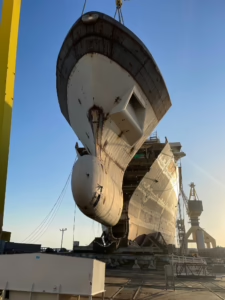
“Shipbuilders have finished installing the bow on the future USS Pittsburgh (LPD 31), bringing another major section of the hull into place. Completing the lift required careful planning and coordination as riggers, crane operators, shipfitters and welders worked to safely position the massive structure, ensuring it aligned with the rest of the hull. Way to go, shipbuilders! Because of your incredible teamwork, another milestone has been achieved on LPD 31.” |
GAO: Submarine Delays Costly: Inside Defense reported on Thursday that The Navy has lost more than 15,000 operational days and spent roughly $3.4 billion due to attack submarine maintenance delays and idle time in the last 10 years, according to a Government Accountability Office report. The GAO recommends the Navy evaluate alternative options for decommissioning attack submarines in an efficient manner to allow for optimized shipyard capacity, like defueling submarines outside of dry docks and reducing crewing throughout this process. Breaking Defense reported on Thursday that the GAO notes between fiscal year 2026 and fiscal year 2030, 15 attack submarines could enter inactive idle time, causing the Navy to accrue more than 14,000 days of idle time and over $3 billion to sustain the inactive submarines. Inactive attack submarines have only faced increases in idle time over the last decade, GAO reports, and one or two submarines have entered this status every year between fiscal year 2016 and fiscal year 2025. The Navy decided to inactivate Los Angeles-class attack submarine Boise (SSN 764) in April, after the vessel awaited an availability at Naval Station Norfolk for nearly a decade. The service cited its plan to optimize fleet composition as reasoning for the inactivation. Boise arrived at HII’s Newport News Shipbuilding division in 2018 and had been undergoing repairs before the Navy’s division to inactive it.
Army Picks Vendors For Nuclear Microreactor Prototypes: Breaking Defense reported on Wednesday that the U.S. Army will pay five vendors as much as $2.2 billion to build and test their nuclear microreactor prototypes for eventual use on military installations. Under the Janus program, the service wants the companies to deliver more than 20 microreactors to Army installations where contractors will own and operate the systems. The five companies and the installations where they will build the microreactors are:
- Antares Nuclear, Inc. at Fort Bragg, NC
- BWXT Advanced Technologies, LLC at Fort Campbell, KY
- General Atomics Electromagnetic Systems at Fort Hood, TX
- Radiant Industries, Inc. at Fort Benning, GA
- Westinghouse Government Services at Fort Drum, NY
Inside Defense reported on Wednesday that the Army launched the Janus program nearly a year ago as a partnership with the Defense Innovation Unit and the Energy Department in response to a directive from the White House to build a nuclear reactor at a domestic military base or installation by the end of September 2028. Project Janus uses a milestone-based payment model, in which each company will receive funding after achieving specific goals over the course of the period from fiscal year 2027 through fiscal year 2031.
HII’s Weekly News Digest is produced by HII’s Corporate Communications team and posted to MyHII every Friday.
Please note: Social media is blocked on HII computers for most employees. Employees are encouraged to visit HII’s Facebook page and other social media sites on personal time and from non-work devices.
Send feedback to: HII_Communications@hii-co.com.