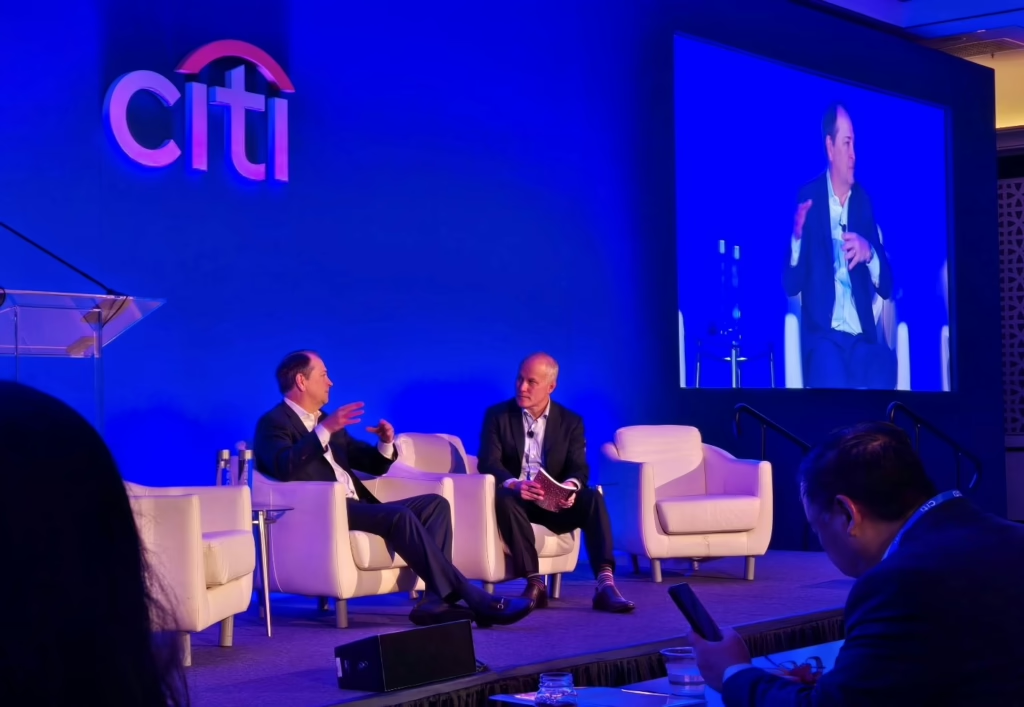

CEO Chris Kastner spoke on Wednesday, Feb. 18, to participants at Citi’s Global Industrial Tech and Mobility Conference.
During his Q&A session, Chris touched on activities in Washington, D.C., HII’s uses of artificial intelligence to improve shipbuilding throughput and how HII’s capabilities align with the national defense strategy.
Below are highlights from the conversation. You can also download the pdf here.
Jason Gursky – Citigroup Inc. – Analyst
I do have a question I wanted to ask you about kind of industrial base costs and the things that the industrial base might be able to do here independent of government action to help drive costs lower, right? There seems to be an administration that’s very focused on the cost.
Chris Kastner – HII President, Chief Executive Officer
So we’re very focused on throughput. I said on the earnings call, we’re going to increase throughput 20% this year versus last year. And the most important thing we can do to control cost is meet our schedules. Because when you have 2,000 to 3,000 people on a ship, if you make schedule, there’s just immediate cost returns related to that.
I think the real cost measures are going to play out over the next one to three years relative to AI. I think it’s real. I think AI technology being implemented in defense companies, not really in touch labor, and support labor in how you do engineering, how you do planning, how you do scheduling, how you do quality, all of that is going to be impacted by AI. It’s just faster than humans are. And I’ve got really great people are working, planning and scheduling and engineering, where you take the burden of the boring work that they do, and we’re were going to see them up to do the kind of complicated stuff they should be doing.
So I think AI is actually going to impact shipbuilding significantly. We’ve got five or six pilots engaged both in Newport News and in Ingalls, evaluating our works. I think there’s going to be returns there.
Jason Gursky – Citigroup Inc. – Analyst
And so, you think the biggest impact will be on schedule, do you think?
Chris Kastner – HII President, Chief Executive Officer
I think it’s cost efficiency and schedule. I think you’re going to be able to be more efficient engineering and planners and quality people you have engaged. So it will help schedule, it will help cost on the specific programs. They all help throughput.
Jason Gursky – Citigroup Inc. – Analyst
So better productivity amongst your labor force, so you need fewer heads, is that kind of the idea?
Chris Kastner – HII President, Chief Executive Officer
Fewer heads across the entire spectrum of planning, engineering, labor. Yes.
Jason Gursky – Citigroup Inc. – Analyst
Okay. And you said you’ve had five pilots going, how long are those pilots going to last? And when do you start to this?
Chris Kastner – HII President, Chief Executive Officer
It would be throughout the year. We’ll start the returns on some of them. Quality is already yielded some really interesting results. If you think about a shipyard, there’s a lot of quality that’s done by hand and on pieces of paper. So we digitized all of that, put it in AI model, evaluate the root causes of a lot of the defects and you can analyze where you’re having issues, and you can address them. So I think there’s real opportunity. I think the Navy sees it as well, and there will be supplemental funding to help us with that.
Jason Gursky – Citigroup Inc. – Analyst
Right. And these are AI models that you’re purchasing off the shelf because of developing –
Chris Kastner – HII President, Chief Executive Officer
Off the shelf, we’re really good partners with AWS involved that it’s also co-investing in these projects and other partners that we’re evaluating to help us take the next step.
Jason Gursky – Citigroup Inc. – Analyst
Can we go to the question about having defense spending. If that were to come to pass, how does that get recognized from your perspective?
Chris Kastner – HII President, Chief Executive Officer
I don’t know. I would love peace in the world. I’m all for world peace. I think the environment, it’s not really realistic to assume that’s going to happen. I know our programs are very well supported by the administration and shipbuilding is — budgets for shipbuilding are only going to increase. And the demand is only going to increase, and the technologies are working on the mission technologies, the demand for those are only increasing, you can see from our growth rate in mission technology. So I don’t see it unless peace breaks out somewhere.
Jason Gursky – Citigroup Inc. – Analyst
Well, speaking about demand for your product, why we don’t shift there really quickly and have you kind of walk us around the world.
Chris Kastner – HII President, Chief Executive Officer
Yeah. So Europe, we don’t have a lot of exposure to Europe. We have some mission technology contracts we’re supporting some of the services in Europe for ISR missions, stuff like that. I don’t know if it’s going to be significantly impacted. I would doubt it. But that’s when we have some unmanned undersea technology that’s deployed in Europe as well, which I think will continue.
The Pacific, obviously shipbuilding in China. That’s not only a submarine aircraft carrier and destroyer play, and the demand couldn’t be greater for our products there. But it’s also the technology play with Mission Technologies and integrated platforms and products and data, what we call Fight Tonight, which is what you deployed right now to help me in the Indo-Pacific. That’s been a benefit of Mission Technologies in the portfolio because we can bundle some of our products, get access and develop in actual demonstrations down in the Pacific, some of the tools that we’re developing. So that’s not going to back up for the homeland. It’s obviously most mission technologies, electronic warfare type of stuff. You mentioned Iron Dome, people don’t think about us as a directed energy business, but we absolutely have a directed energy capability with world class partners that we’re working on contracts with kind of restricted customers to do that.
Jason Gursky – Citigroup Inc. – Analyst
Okay. Fair. But let’s go back to Iron Dome then for a minute and just maybe walk us from your perspective through the, I don’t know, two, three, four key technologies that are going to be need. Obviously, there’s sensors and effectors, but what else is in around the Iron Dome that — do we need any key unlocks here in order to make something like that?
Chris Kastner – HII President, Chief Executive Officer
The largest unlock from me is power and SMRs. So the best power source for — and Iron Dome for us in the United States is not a small area, right? There’s a significant presence that would be required throughout the region, all the regions of the United States, but it’s SMRs. It’s if you can — that will enable from a power source the balance of the technologies to be implemented. So for me, it’s SMRs. And they’re very close. We just have to build some. And I believe that it’s going to take the government to step in to actually take the risk to make the investment to build some SMRs. Now there’s some tech, obviously, some tech companies that are potentially building with data centers. We’ll see if those actually happen, but people are worried about the cost of developing nuclear project, even though SMR obviously do with the cost to run down in Georgia, but SMRs will unlock the ability to execute that technology for Iron Dome. It will solve one of the biggest issues.
Jason Gursky – Citigroup Inc. – Analyst
Understood. Going back to countermeasures on drones. You’ve got very valuable assets that sit out on the water and underneath it. How do we protect those assets from drone swarms and other things. Just kind of curious.
Chris Kastner – HII President, Chief Executive Officer
We have a number of countermeasures on the ship. The question becomes, are you going to shut down a $100 drone with a $1 million missile. I know there’s frustration related to that. I think the risk — well, let me put it this way, the most survivable airfield in the world is an aircraft carrier. We’ll stop right in a conflict, right? But clearly, the Navy is pretty good at protecting those ships. So I have a lot of confidence and you’ve seen their success in the Middle East. So they’re doing a great job at that. And I know they’re developing additional technologies to deal with that. Directed energy is an interesting technology that could be developed for that, which is much less expensive.
Jason Gursky – Citigroup Inc. – Analyst
Talk about the top two or three innovations or structural changes that are affecting the company over the next five years. And I think you talked about AI.
Chris Kastner – HII President, Chief Executive Officer
That is the major structural change. And you don’t have a choice. It’s going to happen, you take advantage of it, get the right partners don’t think you can do it yourself, right? And it’s going to make you more efficient. It’s going to take advantage of it.
Jason Gursky – Citigroup Inc. – Analyst
Okay. Great. Let’s see here. I’m going to ask two quick questions, and then I’m going to go open it to the floor to see if anybody add on the floors kind of question. But why don’t we start with the margin and cash flow forecast for ’25 is dependent on getting some ships under contract. I guess, 10 ships on a Block 6 and on –
Chris Kastner – HII President, Chief Executive Officer
Two on Block 5. The back end of Block 5 and then 10 on Block 6 and then the Columbia-class Build 2.
Jason Gursky – Citigroup Inc. – Analyst
Exactly, right. Is there anything that the Congress especially needs to do to make this happen at this point? Where is the decision-making going on at this point? You mentioned early on our conversation as well. So maybe just understand kind of what the numbers for ’25 forecast and what the risks and opportunities might –
Chris Kastner – HII President, Chief Executive Officer
There’s no barriers to getting the FY25 two boats under contract. Congress did normally added funds, added investments for workforce development and capital and the infrastructure investments. That has all been appropriated. We just are in negotiations with our customer to get that done. And I expect that to get done in the first part of this year.
Block 6 and Columbia Build 2 are a bit more of a challenge. There’s going to be funding challenges is getting those under contract. So there’s more work that needs to be done in the Pentagon and with the administration relative to understanding what that cost is going to be. That’s why SAS was such a beautiful project. It reduced cost accelerated submarine production immediately infused significant investment into the industrial base. And they did it by — that’s restructuring the contracts and really acquisition approach. And I don’t want to get into the details on how that works, but it just restructures the contracts that enables that. That makes it fit, that makes the budget fit, supports US submarine production and augurs. So it’s a significant initiative. It’s still in play, waiting these FY24 two boats done, and then we’ll pivot to that because that enables Block 6 and the Columbia Build 2.