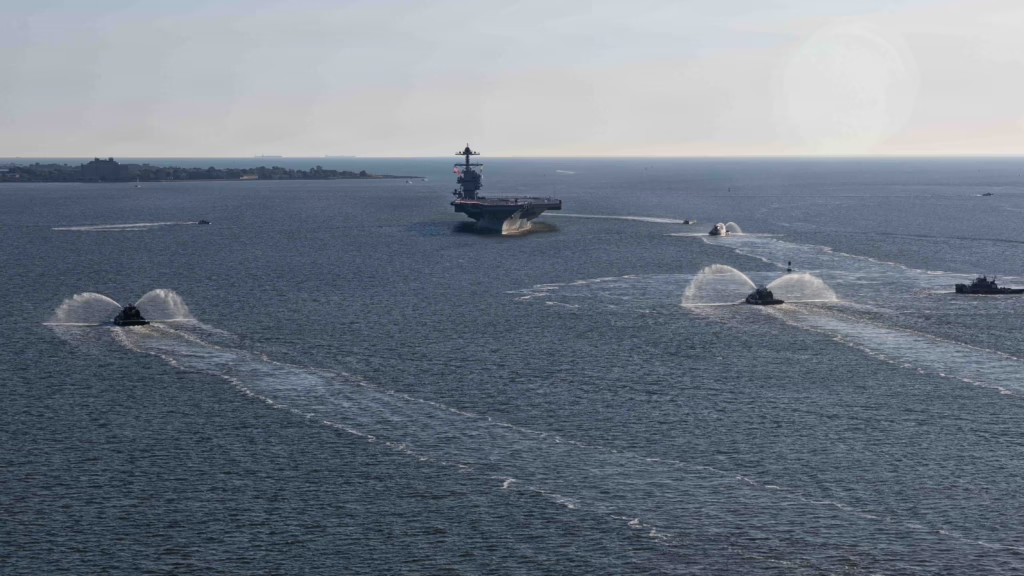

Photo caption: NORFOLK, Va. (May 16, 2026) USS Gerald R. Ford (CVN 78) returned to Naval Station Norfolk, May 16, 2026, following a historic 11-month deployment to U.S. 2nd, 4th, 5th, and 6th Fleets as part of the Gerald R. Ford Carrier Strike Group. Ford was built at HII’s Newport News Shipbuilding division. (U.S. Navy photo by Mass Communication Specialist 2nd Class Mike Shen)
May 22, 2026
HII’s Weekly News Digest is compiled every Friday by the Corporate Communications team to summarize and highlight news stories of significance to the company.
Navy Eyes NNS For Final Assembly Of Nuclear-Powered Battleship: Inside Defense reported on Wednesday that final assembly of the Trump-class battleship will take place at HII’s Newport News Shipbuilding. Jason Potter, who is currently performing the duties of assistant Navy secretary for research, development and acquisition, told the members of the House Armed Services seapower and projection forces subcommittee that the Navy is specifically eyeing Dry Dock 12 at NNS. USNI News reported on Thursday that ship modules will be built across the country, then shipped to NNS where the final assembly will take place. Coordination within the dry dock will also be needed. “There is a path here where we need to work on the phasing with (Gerald R. Ford-class aircraft carriers Doris Miller and William J. Clinton) and the battleship, but we view there is capacity with the way in which that dry dock can be configured,” Potter said. Breaking Defense has previously reported the battleships will be outfitted with the same nuclear reactor that powers Ford-class aircraft carriers. The service plans to buy the first battleship in fiscal year 2028 and spend over $43 billion to procure three of the vessels over the next five years. The Navy is seeking $1 billion in FY2027 for advanced procurement and $837 million for research and development funding.
HII Delivers USV Prototypes To US Marine Corps: Workboat reported on Friday, May 15, that HII and MetalCraft Marine have delivered and sea-tested two autonomous unmanned surface vessel prototypes for the U.S. Marine Corps. The two ROMULUS-25 USVs were delivered in December 2025 and recently completed testing and demonstrations of autonomous mission behaviors at sea. Work was completed under a Defense Innovation Unit contract focused on smaller-form autonomous boats. Defence Blog reported on Saturday that the ROMULUS-25 is designed as a high-speed interceptor vessel capable of carrying up to 1,000 pounds of payload with a range of up to 1,000 nautical miles. The vessel operates autonomously using HII’s Odyssey autonomy suite, an artificial intelligence-enabled system designed to integrate multiple sensors and effectors for maritime operations.
Ford Deployment Extension Disrupts Carrier Maintenance Schedules: 13NewsNow reported on Saturday that the USS Gerald R. Ford (CVN 78) and its carrier strike group arrived at Norfolk Naval station that morning, more than 11 months after heading out on deployment. Returning to port were nearly 4,500 sailors assigned to the Ford, along with USS Bainbridge (DDG 96) and USS Mahan (DDG 72). Defense Secretary Pete Hegseth was in Norfolk for the homecoming, welcoming sailors alongside their families following the extended time at sea. Stars and Stripes reported on Saturday that Ford crisscrossed the Atlantic four times, led attacks on two continents, launched hundreds of sorties, and its strike group fired scores of missiles. Bryan Clarke, an analyst for the Hudson Institute, said the extra-long deployment scrambled the Navy’s timetable for ship repairs, leaving a cascading impact at the Navy’s shipyards. Under the Navy’s Optimized Fleet Response Plan, each of the 11 carriers is plotted into a staggered 36-month schedule divided into deployment, sustainment, training and maintenance. Aircraft carriers are designed to deploy for up to seven months, but the Ford was at sea for 11. The Navy is still assessing how the ship’s extended deployment will affect repair schedules.
| Social Media Highlight Of The Week
Posted May 22 on Mission Technologies’ LinkedIn page:
“Advancing ISR, Irregular Warfare & EA Capabilities for Global SOF Our team is on the ground in Tampa with operators who are looking for technology solutions to solve USSOCOM’s and Global SOF’s hardest problems. Whether ISR, irregular warfare or electronic attack, we are uniquely able to support sensitive missions, reduce risk and ensure our warfighters and partner forces maintain their strategic advantage. Make sure to check us out at SOF Week’s newest feature — The Outpost, to see our technology in real operational environments. 📍 Take the water taxi to Davis Island and find us at SD3. |
Caudle Discusses Ballistic Missile Submarine Extension Strategy: Defense Daily reported on Wednesday that the Navy’s top officials confirmed the service life of at least one Ohio-class ballistic missile submarine will be extended using a process known as “post-inactivation, restricted availability,” or PIRA, to help fulfill the service’s requirements before the first Columbia-class SSBN comes online. Chief of Naval Operations Adm. Daryl Caudle discussed the service’s strategy to extend the life of several nuclear-armed Ohio-class ballistic missile submarines with senators during an Armed Services Committee hearing this week. The Navy wants to learn from the first PIRA in ways that will create quicker turnarounds if the service lives of more Ohio-class boats need to be extended. Caudle said General Dynamics is trying to deliver the first-in-class District of Columbia (SSBN 826) in 2028. He noted all the super modules of SSBN 826 are in place at GD Electric Boat’s facility in Quonset Point, Rhode Island. The chief naval officer said the contractor is trying to speed up the delivery timeline by doing non-destructive testing in the off hours, adding more robotic welding, improving artificial intelligence utilization to improve workflows and management of actual technical work documents.
FF(X) Design Remains On Track: Inside Defense reported on Thursday that the Navy, working with HII’s Ingalls Shipbuilding division, is on track to complete the new FF(X) frigate design by the end of this month. The frigate is based on the HII-built Legend-class national security cutter already in use by the Coast Guard. According to recent budget documents, one frigate will be procured in fiscal year 2027 for $1.4 billion and completion of the critical design review for the lead ship is scheduled for May 2026. Design efforts for FF(X) will include modifications from the NSC vessel and will aim to align the frigate with the Navy’s containerized payloads initiative. The frigate will primarily act as a “command ship for tailored offsets, including robotic and autonomous systems,” according to budget documents. Modifications will include the incorporation of Navy weapons, combat systems, producibility enhancements, while future flights might add expanded capabilities like vertical launch systems and anti-submarine warfare systems, the documents add.
HII’s Weekly News Digest is produced by HII’s Corporate Communications team and posted to Homeport every Friday.
Please note: Social media is blocked on HII computers for most employees. Employees are encouraged to visit HII’s Facebook page and other social media sites on personal time and from non-work devices.
Send feedback to: HII_Communications@hii-co.com.