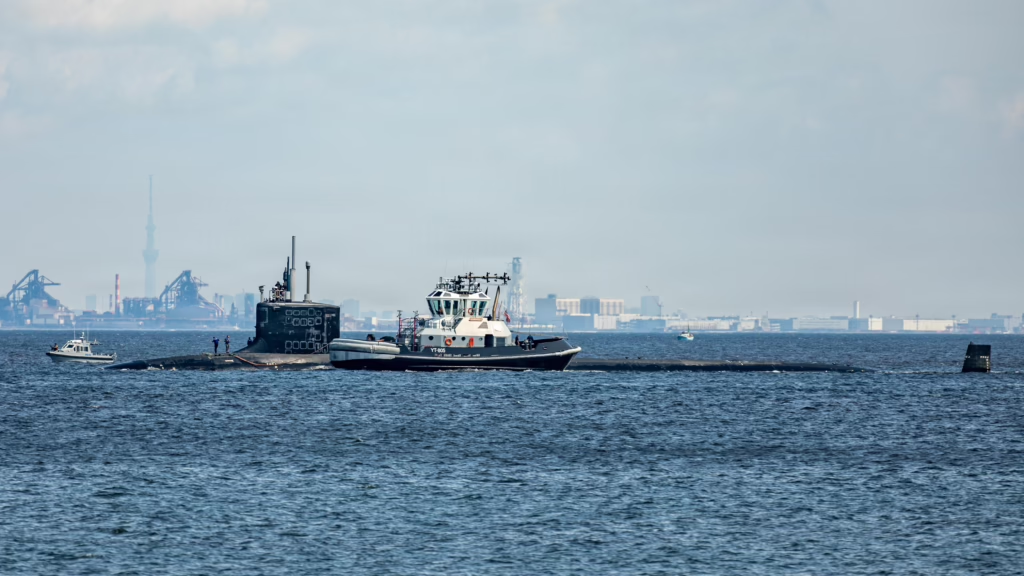

Photo caption: Virginia-class fast-attack submarine USS Montana (SSN 794) transits Tokyo Bay, April 28, 2026. Montana, homeported in Pearl Harbor, Hawaii, was built at HII’s Newport News Shipbuilding division. (U.S. Navy photo by Mass Communication Specialist 2nd Class Daniel G. Providakes)
May 15, 2026
HII’s Weekly News Digest is compiled every Friday by the Corporate Communications team to summarize and highlight news stories of significance to the company.
General Dynamics Wins $2.3 Billion Virginia-Class Contract As Caudle Predicts Construction Ramp Up: Inside Defense reported on Monday that General Dynamics Electric Boat has received a $2.3 billion Navy award for Block VI Virginia-class submarine long-lead-time material and early manufacturing. A Pentagon announcement made Monday suggests the Navy might soon ink a production contract for 10 or more Virginia-class boats after a years-long delay. Congress granted funding and multiyear procurement authority for up to 13 of the vessels in 2023, but the Navy has yet to reach a deal with contractors, including HII whose Newport News Shipbuilding division teams with General Dynamics to build Virginia-class and Columbia-class submarines. The two companies are also awaiting delayed contracts for five Build II Columbia-class ballistic missile submarines. Meanwhile, USNI News reported on Tuesday that shipbuilders are on track to deliver two Virginia-class attack submarines per year in the early 2030s. Chief of Naval Operations Adm. Daryl Caudle told defense appropriators that investments in the submarine industrial base and workforce, and the expansion of distributed construction are helping builders accelerating throughput so they can hit the two-a-year delivery rate for the attack boats by 2032. Caudle’s comments are in line with the goal the service has set to achieve a rate of two Virginia-class attack submarine and one Columbia-class nuclear ballistic missile submarine per year by Fiscal Year 2031 as a justification of $6.2 billion in submarine industrial base spending, according to the Navy’s long-range shipbuilding plan released on Monday.
Shipbuilding Plan: Trump-Class Battleship To Be Nuclear Powered: USNI News reported on Monday that the new Trump-class battleship will be powered by a nuclear reactor, according to the Navy’s annual 30-year shipbuilding blueprint. The shipbuilding plan published Monday acknowledges for the first time the estimated $17.5 billion battleship could be nuclear powered. In the next 30 years, the Navy wants to buy 15 new Trump-class battleships. Interesting Engineering reported on Monday that the Navy had previously connected the project to the DDG(X) program, which was meant to be the next large surface warship after the Arleigh Burke destroyers. However, the new shipbuilding proposal argues the DDG(X) design involved compromises the Navy no longer wants to accept. The new shipbuilding plan also provides, to date, the most concrete details of the Navy’s acquisition strategy for medium unmanned surface vessels. The 2025 Budget Reconciliation Act provided more than $5 billion to acquire the autonomous ships designed to carry up to two 40-foot shipping containers for a variety of missions. Instead of developing a major acquisition program, the service will instead buy MUSVs off the shelf under the government’s “other transaction authority,” allowing the Navy to make purchases outside of the normal contract reporting process. Under the plan, the Navy is set to buy 36 MUSVs this year.
NNS Awards Australian Company Contracts Under AUSSQ Program: Australia Defence Magazine reported on Thursday that HII’s Newport News Shipbuilding division has awarded contracts to South Australian manufacturer Century Engineering to produce precision-engineered parts for U.S. aircraft carriers. Century Engineering is the first Australian business to secure export contracts into the United States naval nuclear supply chain after qualifying through the Australian Submarine Supplier Qualification (AUSSQ) Program. The company is expected to deliver crank components, which will begin within weeks. It is the first time an Australian company has delivered parts into a live nuclear-powered naval program, signaling progress in Australia’s role within allied AUKUS supply chains. Delivered by H&B Defence on behalf of the Australian Submarine Agency, AUSSQ is designed to identify, uplift and qualify Australian businesses to meet the exacting requirements of U.S. and United Kingdom nuclear-powered submarine enterprises, creating a direct pathway into AUKUS-aligned programs. To date, 13 Australian companies have qualified for inclusion in the U.S. submarine industrial base through AUSSQ.
| Social Media Highlight Of The Week
Posted Friday, May 8, on HII’s Facebook page:
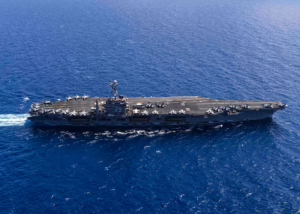
“#OnThisDay🗓️: Harry S. Truman was born on May 8, 1884 in Lamar, Missouri. Serving as the 33rd president of the United States, Truman led the country through the final stages of World War II and the early years of the Cold War. USS Harry S. Truman (#CVN75), was built by our #NewportNewsShipbuilding division as the eighth Nimitz-class nuclear-powered aircraft carrier and named in his honor. She was launched in September 1996 and commissioned into the U.S. Navy fleet in July 1998. #DidYouKnow 💡: The Truman Carrier Strike Group (Carrier Strike Group 😎 was awarded the Combat Action Ribbon in 2025 for its operations while on deployment in the Red Sea. We’re proud to have built this ship that continues to serve as a key asset in U.S. naval operations. 📸: U.S. Navy/MC3 Shen” |
Destroyer Ted Stevens (DDG 128) Sails Away From Ingalls: WLOX reported on Friday, May 8 that Flight III Arleigh Burke-class guided missile destroyer Ted Stevens (DDG 128) departed HII’s Ingalls Shipbuilding division enroute to its homeport in Norfolk, Virginia. Naval Technology reported Monday the ship will be commissioned this fall in Whittier, Alaska, which the ship’s namesake, former U.S. Sen. Ted Stevens, represented for more than four decades. DDG 128 is the second Flight III Arleigh Burke-class destroyer built and delivered by Ingalls, which currently has five additional Flight III destroyers under construction and seven more in early pre-planning and material procurement phases.
Gold Dome Now Comes With Estimated $1.2 Trillion Price Tag: Defense News reported on Tuesday that the Golden Dome national missile defense system could cost $1.2 trillion to build and maintain over the next 20 years. The nonpartisan Congressional Budget Office estimate is based on a four-tiered defense system: a space-based layer, upper- and lower-level surface interceptor layers and multiple spread-out surface interceptors, which would provide protection for all of the continental U.S. plus Alaska and Hawaii. The system would defend against multiple missiles fired simultaneously and would protect against threats from hypersonics, ballistics and cruise missiles. However, it could not successfully engage with a large-scale attack from a peer or near-peer adversary like Russia or China, according to the report. As the cost estimate is based on the desired capabilities laid out in a January 2025 executive order, it doesn’t include funding for research and development of future technologies, nor does it take into account ground forces or a communication system necessary to make the proposed system work. The Associated Press reported on Tuesday that the CBO’s estimates are in part based on a lack of details from the Defense Department about what and how many systems will be deployed, “making it impossible to estimate the long term cost” of the Golden Dome system.
HII’s Weekly News Digest is produced by HII’s Corporate Communications team and posted to Homeport every Friday.
Please note: Social media is blocked on HII computers for most employees. Employees are encouraged to visit HII’s Facebook page and other social media sites on personal time and from non-work devices.
Send feedback to: HII_Communications@hii-co.com.