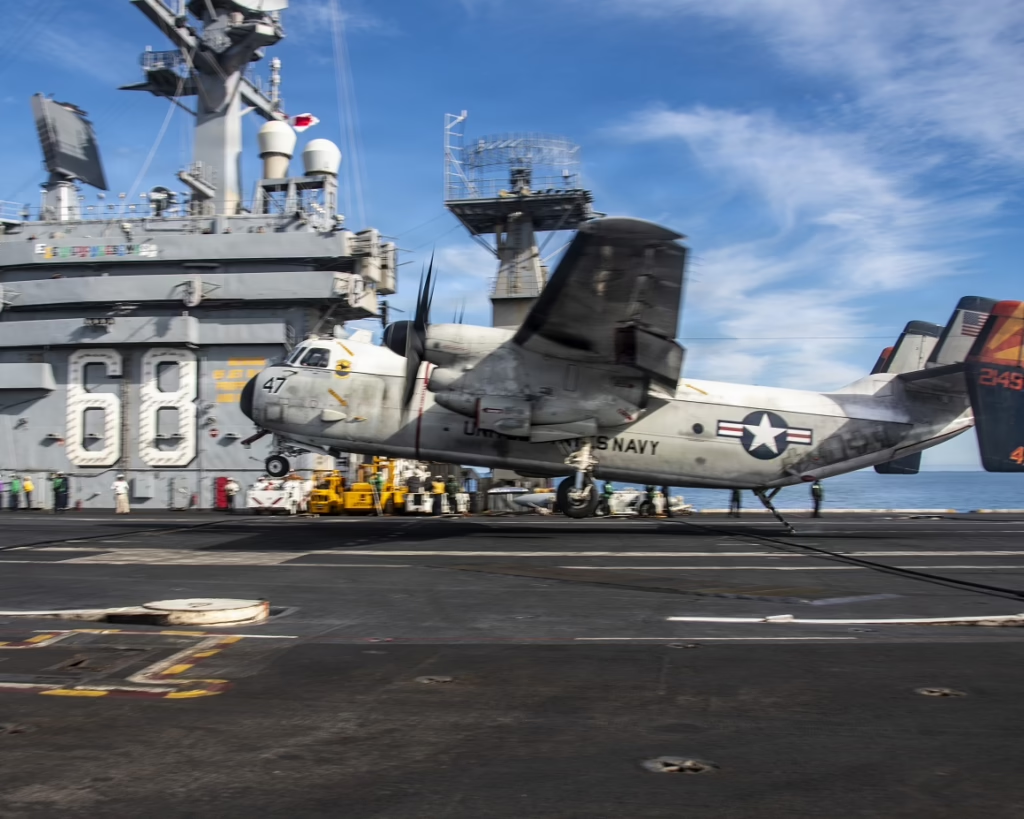

Photo caption: A C-2A Greyhound, attached to the “Rawhides” of Fleet Logistics Support Squadron 40, makes an arrested landing on the flight deck of Nimitz-class aircraft carrier USS Nimitz (CVN 68). Nimitz is deployed as part of Southern Seas 2026 which seeks to enhance capability, improve interoperability, and strengthen maritime partnerships with countries throughout the region through joint, multinational and interagency exchanges and cooperation. (U.S. Navy photo by Mass Communication Specialist 2nd Class Jaron Wills)
April 17, 2026
HII’s Weekly News Digest is compiled every Friday by the Corporate Communications team to summarize and highlight news stories of significance to the company.
US Navy Amasses In Middle East To Enforce Iranian Blockade: Stars and Stripes reported on Tuesday that a third Navy aircraft carrier strike group and additional minesweepers are headed to the Middle East to enforce a U.S. blockade against Iran and control the Strait of Hormuz. The impending arrival of about six more ships will put at least 27 Navy vessels — roughly 41% of the service’s ships actively deployed and operating at sea worldwide — in the region, according to a Stars and Stripes analysis of USNI News Fleet Tracker data. The additional forces — on top of at least 21 Navy warships and more than 16,500 sailors and Marines already in the region — would give commanders greater flexibility in enforcing a U.S. blockade enacted Monday, aimed at throttling back Iran’s economy and forcing its leadership to curb its nuclear program. The New York Times reported on Thursday that some ships without links to Iran did move through the strait on Monday and Tuesday, according to U.S. Central Command. The vessels stayed close to the Omani coast, keeping a distance from possible sea mines in the middle of the waterway. The Associated Press reported on Wednesday that Iran-linked or sanctioned vessels that have left the Persian Gulf through the Strait of Hormuz have stopped or turned around. The New York Times reported on Friday that Iran declared the straight as being open to commercial vessels, while President Donald Trump said the US blockade on Iranian ports will continue.
Caudle: Foreign Shipbuilders Could Build, Maintain Auxiliary Vessels: Defense Daily reported on Monday that Chief of Naval Operations Adm. Daryl Caudle envisions leveraging foreign shipyards in ways that will improve U.S. Navy shipbuilding. That may mean maintaining and building some of the U.S. Navy’s auxiliary ships. Caudle said he is focused on trying to entice allied country shipbuilders to invest in the U.S., either by standing up new shipyards and capacity in-country or partnering to invest in an existing shipyard to expand its offerings. Caudle argued maintenance and repair of auxiliary ships in Military Sealift Command can readily be offloaded to foreign allies, especially considering those ships do not have classified combat spaces. The news comes as Hanwha’s CEO has said the company’s U.S. arm is building a proposal to construct the U.S. Navy’s landing ship medium and other unmanned classes of ships. Inside Defense reported on Thursday that Hanwha Defense USA CEO Michael Coulter said the company is executing a $5 billion infrastructure improvement plan at the Philly Shipyard and is clearing its existing backlog to make room for new work. The company, a subsidiary of South Korean defense giant Hanwha, aims to become a major player in domestic shipbuilding, taking on auxiliary and eventually combatant vessel production work at Philly Shipyard.
USS Gerald R. Ford (CVN 78) Breaks Deployment Record: USNI News reported on Wednesday that USS Gerald R. Ford (CVN 78) has broken the record for the longest carrier deployment since the early 1990s. On Wednesday, Ford’s deployment hit the 295-day record previously set by USS Abraham Lincoln (CVN 72) in the early days of the COVID-19 pandemic during its Middle East deployment and homeport shift from the East Coast to San Diego, California. Ford is the first in its class and was built at HII’s Newport News Shipbuilding division. The carrier, currently in the Eastern Mediterranean, left June 24, 2025, from Naval Station Norfolk for Europe before being shifted in October to the Caribbean Sea as part of the wider Pentagon naval presence ahead/ Then in February, Ford was tasked to the Middle East and eventually the Red Sea. The extended deployment is set to last until May and could rival Vietnam-era deployments based on testimony from Navy leaders earlier this year.
| Social Media Highlight Of The Week
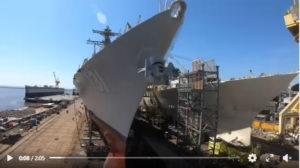
Posted Tuesday on Brian Blanchette’s Facebook page: “What a milestone for DDG 131 and for every Ingalls shipbuilder who brought her to this point. The launch of the future USS George M. Neal (DDG 131) is a powerful reminder of what skilled hands and a mission focused workforce can achieve together. Thank you for turning raw steel into a warfighter ready asset now on its path to be delivered to the fleet.” |
New Alabama Plant To Supply Submarine Components: Al.com reported on Monday that Hadrian Automation is partnering with the Navy to transform a 2.2 million-square-foot former railcar plant in Cherokee, Alabama, into a submarine manufacturing facility. The manufacturing company is investing $1.5 billion into the facility while the remaining $900 million is coming from the One Big Beautiful Bill. The facility will become an advanced, highly automated manufacturing plant that will mass-produce components needed for Columbia– and Virginia-class submarine construction, including parts, assemblies, and finished products. Fox54 reported on Friday, April 10, that the facility could create more than 1,000 jobs. Hadrian has four facilities totaling approximately 2.85 million square feet across California, Arizona, and Alabama, and is developing additional production sites covering the full suite of production, from components to complete products and assemblies.
Rolls-Royce: AUKUS Submarine Reactors In Production: The UK Defence Journal reported on Wednesday that Rolls-Royce Submarines has reached the point that it is actively producing PWR3+ nuclear reactors for SSN-AUKUS attack submarines. James Lowe, director of future programmes at Rolls-Royce Submarines, said reactor production at Rolls-Royce’s Derby site aims to produce a consistent delivery across multiple hulls. Lowe told participants at the Undersea Defence Technology exhibition in London, that the company has ordered material and parts for the first seven boats and production has started in Derby for the first boat. Army Technology reported on Tuesday that the trilateral AUKUS partnership will provide Australia with at least three SSN-AUKUS boats while Britain receives 12 of them. Lowe said the company plans to deliver reactors by the mid‑2030s. While the first units will be completed every 18 months, follow-on units will be delivered at 12‑month intervals into the late 2030s. To support the expected increase in production demand, Rolls-Royce is preparing a major expansion of its Derby facilities, alongside the use of satellite sites to increase engineering capacity.
HII’s Weekly News Digest is produced by HII’s Corporate Communications team and posted to Homeport every Friday.
Please note: Social media is blocked on HII computers for most employees. Employees are encouraged to visit HII’s Facebook page and other social media sites on personal time and from non-work devices.
Send feedback to: HII_Communications@hii-co.com.