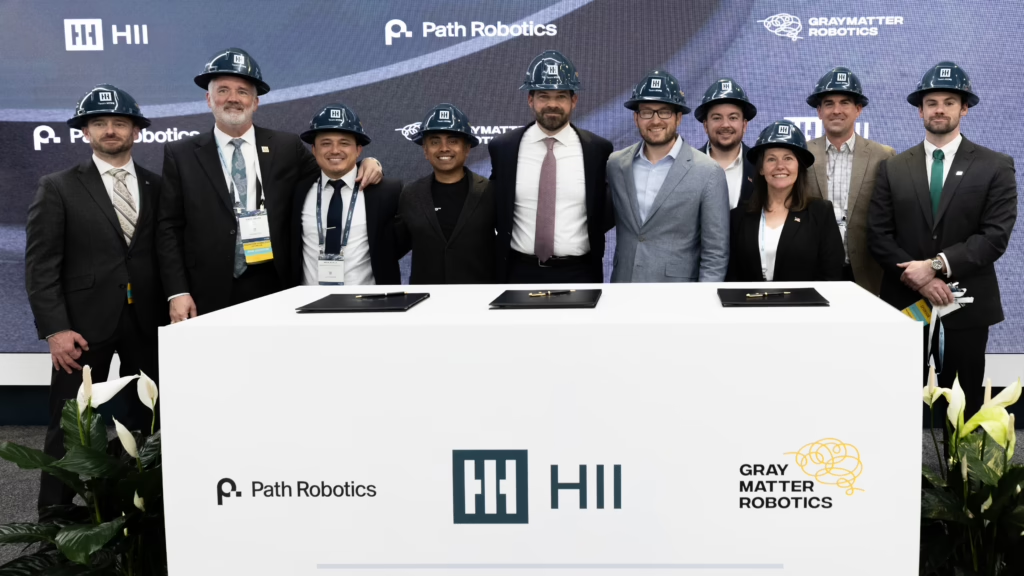

NATIONAL HARBOR, Md., (April 20, 2026) — At the U.S. Navy League Sea-Air-Space Expo 2026, HII (NYSE: HII), together with Path Robotics and GrayMatter Robotics, introduced the High-Yield Production Robotics (HYPR) program. The program seeks to leverage a network of emerging physical AI technologies from Path Robotics and GrayMatter Robotics to rapidly accelerate advanced, adaptive automation solutions in the fabrication process of both crewed and uncrewed naval platforms.
“Integrating our partnerships into one HYPR team will enable us to leverage each other’s best-in-class capabilities to accelerate shipbuilding throughput, strengthen the maritime industrial base and augment our shipbuilding work,” said Eric Chewning, executive vice president of maritime systems and corporate strategy at HII. “This HYPR initiative will allow us to apply next-generation robotics to complex, variable shipbuilding tasks that have been difficult to fully automate. We look forward to teaming physical AI technologies together to create fewer labor hours per hull, more predictable schedules, and a production model that can scale to meet the Navy’s generational demand signal.”
HYPR, developed with support from HII’s Dark Sea Labs Advanced Technology Group, will combine robotic welding, automated material movement, autonomous surface treatment, and autonomous quality checks into an assembly line designed to produce increased speed and efficiency of ship and submarine construction. In 2026, HII plans to run proof-of-concept demonstrations with its partners. A full pilot program is expected to launch in 2027.
The program reflects a broader push within U.S. defense to expand naval capacity, modernize shipbuilding, and bring more scalable manufacturing methods into production to support building the nation’s golden fleet.
Production of critical material for integration into Navy platforms remains one of the main constraints in shipbuilding and submarine construction, and complex assemblies in particular require seamless coordination of many specialized skills and tasks to compress production cycle times. HYPR is designed for adaptive automation across the full structural process, from
cutting and fitting parts to surface prep, welding, inspection, blasting and coating.
“Welding is one of the most complex processes to automate in any industry, and shipbuilding raises that bar even higher,” said Andy Lonsberry, Path Robotics CEO and co-founder. “Path Robotics’ physical AI is engineered for exactly this challenge — moving, seeing, understanding and adapting to real-world conditions in real time to deliver precise, high-quality welds at scale. We look forward to working with the HYPR partners to put that capability where it matters most, accelerating production of the manned and unmanned vessels that protect our nation for whatever comes next.”
Instead of adding standalone automation tools, HYPR combines multiple systems into a single coordinated production line.
The pilot program brings together technologies from two automation firms:
- Path Robotics: Physical artificial intelligence (AI) for manufacturing.
- GrayMatter Robotics: Factory SuperIntelligence (FSI) for surface preparation, finishing, coating, and inspection.
Together, these systems are starting work on the highly specialized and interconnected steps of structural fabrication and assembly, which directly influences cost, schedule and the need for outside suppliers on major naval programs.
“This partnership is a step toward increasing industrial capacity in one of the most critical sectors for national security. We’ve already deployed our systems across demanding production environments across industries and this collaboration allows us to apply and scale that capability further within shipbuilding, alongside Path and HII,” said Ariyan Kabir, GrayMatter Robotics CEO and co-founder. “More broadly, it reflects a shift toward what we call Factory SuperIntelligence — where these systems move beyond automating individual tasks to helping entire production environments operate more efficiently, adapt in real time and scale.”
HII will provide shipbuilding expertise, production demand and qualification pathways. In return, the partners contribute engineering investment and deliver cost-competitive materials, along with automation systems that can scale across programs.
Chewning said this approach shares development risk while strengthening long-term production capacity.
HYPR supports HII’s broader goal of expanding output for both crewed and autonomous platforms. The pilot program is expected to support structural needs for the ROMULUS unmanned surface vessel family, as well as structural assemblies for surface combatants and submarines.
The initiative also aligns with growing international industrial cooperation, including AUKUS-related submarine industrial base efforts and distributed production strategies among allied shipbuilders.