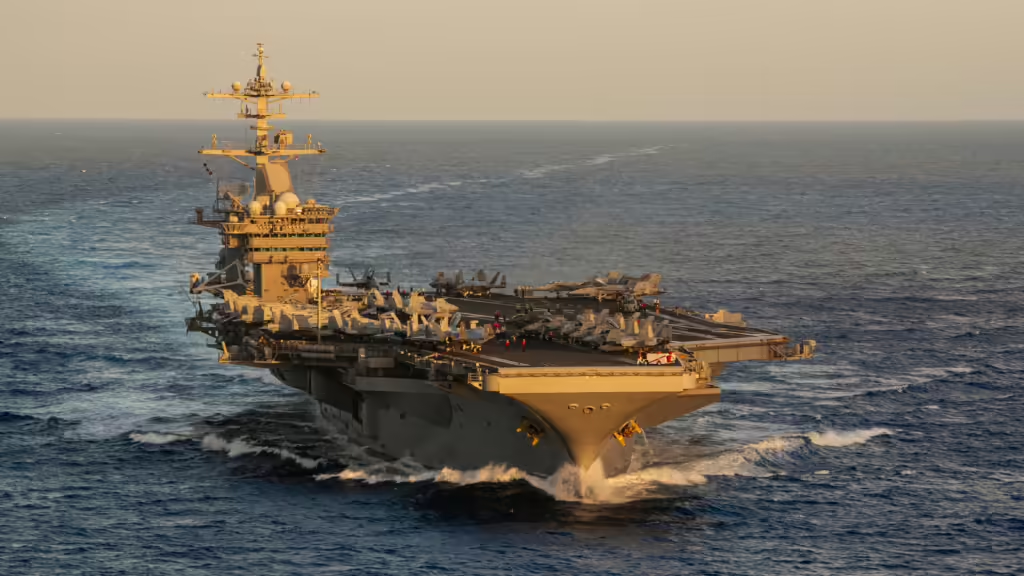

Photo caption: Nimitz-class aircraft carrier USS George Washington (CVN 73) transits the Pacific Ocean, Oct. 18, 2024, as an integral part of U.S. Pacific Fleet. CVN 73 was built and delivered to the U.S. Navy by HII’s Newport News Shipbuilding division, and the ship completed its midlife overhaul at NNS in 2023. (U.S. Navy photo by Mass Communication Specialist Seaman Geoffrey L. Ottinger)
Oct. 25, 2024
HII’s Weekly News Digest is compiled every Friday by the Corporate Communications team to summarize and highlight news stories of significance to the company.
Navy Seeks Industry Partnership on West Coast Dry Dock: Inside Defense reported on Friday, Oct. 18 that the Navy is contemplating a collaborative public-private approach to buying and operating a new dry dock on the West Coast. A request for information posted by the Navy notes the service may want to enter into a business partnership with a commercial entity to share production costs and use of the infrastructure. According to the RFI, the Navy plans to use the dry dock specifically to maintain Ford-class aircraft carriers, although the dock would also be capable of hosting other ships including Nimitz-class carriers and nuclear-powered submarines. When the dock is not being used for Navy vessel maintenance, the industry partner would be free to use it for commercial work. Mark Edelson, program executive officer for industrial infrastructure at naval facilities engineering systems command, said the Navy is making progress expanding its maintenance capabilities via the Shipyard Infrastructure Optimization Program, a 20-year, $21 billion effort launched in 2018 to modernize the nation’s four public shipyards. Under SIOP, three new dry docks are currently under construction at the Navy’s public yards while a fourth dry dock at Norfolk Naval Shipyard is being renovated.
General Dynamics Cites Submarine Supply Chain Woes During Third Quarter Call: Breaking Defense reported on Wednesday that General Dynamics Electric Boat isn’t getting what it needs from its supply chain on time, forcing the company to reconsider its promise to deliver two Virginia-class attack submarines per year under “considerable pressure,” CEO Phebe Novakovic said during an earnings call with investors. Novakovic acknowledged that the Navy and Congress understand the industrial base challenges and have directed funding — to the tune of $11 billion planned for the immediate upcoming budget cycles —to help shore up manufacturing capacity, although she said further investments may be necessary. Inside Defense reported on Wednesday that supplier issues are not expected to further delay Columbia– and Virginia-class submarine schedules, although Novakovic indicated General Dynamics Electric Boat will “adjust our pace” to align with the slower-than-desired rate of component deliveries. Despite these issues, General Dynamics’ marine business was profitable during the quarter, with revenue of $3.6 billion, marking a 20% increase over the third quarter of 2023. Overall, executives reported revenue of $11.7 billion during the quarter, an increase of over 10% compared to the third quarter of the previous year.
Austal Breaks Ground On Submarine Facility: WPMI reported on Wednesday that Austal USA has broken ground on a module manufacturing facility that will be used to support the U.S. Navy submarine industrial base. The module manufacturing facility will provide 369,600 square feet of indoor manufacturing space to build the submarine modules, specifically for the Columbia and Virginia classes. The event comes after a groundbreaking in July on a new final assembly building which will allow for Austal to build steel modules for Navy and Coast Guard ships. The buildings are expected to bring a combined 2,000 new jobs to the area when fully operational.
AUKUS Nations Test Pillar II Technologies During Autonomous Warrior 24: Inside Defense reported on Thursday that the United States, United Kingdom and Australia are wrapping up three weeks of maritime experimentation using uncrewed systems and a variety of other emerging technologies. The Autonomous Warrior 24 exercise seeks to develop maritime capabilities and enhance interoperability under the technology-focused second pillar of AUKUS. The nations tested 30 different systems — including communication network technologies, unmanned surface and undersea vehicles, and unmanned aircraft — during the Australia-based exercise that will help participants develop a common operating picture. The Australian Broadcasting Corp reported on Thursday that Japanese defense officials attended the exercise as “observers” and that similar events planned for next year may include the country as a participant. Unnamed defense officials quoted in the article cite Japan’s deep industrial base in autonomous and robotic systems, making it an ideal partner in AUKUS’ Pillar II moving forward.
| Social Media Highlight Of The Week
Posted Thursday on HII’s Facebook page:
“Fifty years of familia! HII is proud to return as a sponsor of the SHPE National Convention from October 30-November 3, 2024, at the Anaheim Convention Center in Anaheim, Calif., for the convention’s 50th anniversary. Come network with us and other attendees in our Hospitality Suite and Career Fair booth. We’ll also be conducting interviews for on-the-spot job offers! Learn more about what this year’s conference has to offer and which positions we’re looking to fill here: https://hii.com/events/shpe-convention-2024/. Visit http://HII.com/careers to learn how you can become part of #TeamHII. #SHPE2024” |

F-35 Pinch Slows Lockheed’s Q3 Earnings: Defense One reported on Wednesday that longer-than-expected negotiations over the Pentagon’s next two batches of F-35s kept Lockheed Martin from collecting about $700 million last quarter, company officials told participants during the company’s third quarter earnings call on Tuesday. Lockheed hasn’t struck a deal for the next two F-35 production lots, so the company has needed to spend its own cash to keep the production line running. Breaking Defense reported on Wednesday that Lockheed expects to reach a deal with the Pentagon in the fourth quarter, allowing it to recover by the end of 2024. However, the company warned that until a final contract is reached or the Pentagon provides additional funding, its financial results could be negatively impacted. “Should the negotiation timeline be extended beyond year end … we could see about 3 percent or $2 billion of our sales shift into 2025, along with associated impacts to profit and about $1 billion dollars of free cash flow,” said Lockheed Chief Financial Officer Jay Malave during the call. The jet builder will also have to absorb $600 million this year after the Pentagon paused the acceptance of new jets due to delays with new technology that was supposed to be loaded onto the jet, called Technology Refresh-3. After deliveries resumed in late August, the Pentagon said it would withhold about $5 million per jet until the full upgrade was complete. The Wall Street Journal reported that overall, Lockheed reported net earnings of $1.6 billion during the quarter, compared to $1.7 billion a year earlier. Still, the company lifted its 2024 earnings forecast to $26.65 a share, from a previous range of $26.10 to $26.60 a share.
HII’s Weekly News Digest is produced by HII’s Corporate Communications team and posted to Homeport every Friday.
Please note: Social media is blocked on HII computers for most employees. Employees are encouraged to visit HII’s Facebook page and other social media sites on personal time and from non-work devices.
Send feedback to: HII_Communications@hii-co.com.