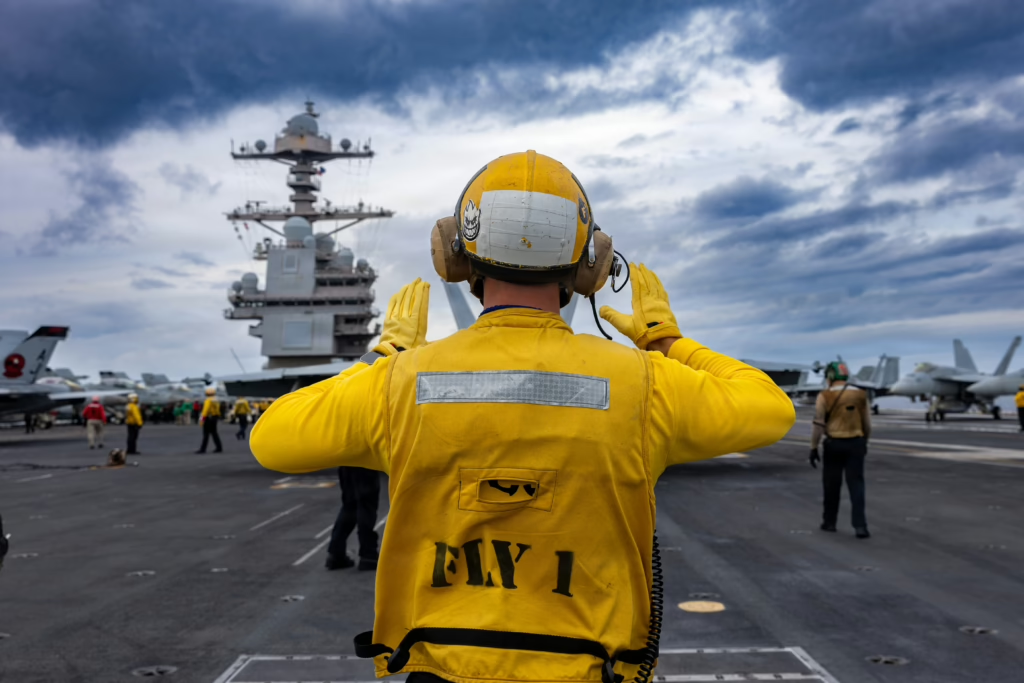

Photo caption: Aviation Boatswain’s Mate (Aircraft Handling) 2nd Class Tristan Wyns, assigned to Air Department aboard the world’s largest aircraft carrier, USS Gerald R. Ford (CVN 78), signals to an F/A-18F Super Hornet attached to Strike Fighter Squadron 213, on the flight deck, Oct. 30, 2025. Gerald R. Ford, a first-in-class aircraft carrier and deployed flagship of Carrier Strike Group 12, was built at HII’s Newport News Shipbuilding division. (U.S. Navy photo by Mass Communication Specialist Seaman Apprentice Zamirah Connor)
Nov. 7, 2025
HII’s Weekly News Digest is compiled every Friday by the Corporate Communications team to summarize and highlight news stories of significance to the company.
HII, Shield AI Complete First ROMULUS Autonomy Test: ExecutiveBiz reported on Tuesday that HII and Shield AI have completed their first major integration test of autonomy software aboard the ROMULUS 20 unmanned surface vessel. The three-day trial in Virginia Beach, Virginia, marked the first maritime deployment of Shield AI’s Hivemind system, which enables unmanned systems to execute autonomous missions across domains. The test combined HII’s Odyssey suite with the Hivemind Enterprise software development kit. HII’s ROMULUS is a modular, high-performance USV line; its lead vessel, ROMULUS 190, is under construction and designed for speeds over 25 knots and ranges up to 2,500 nautical miles. Ocean News & Technology reported on Wednesday that the ROMULUS program also includes a strategic collaboration with Australia-based Incat Crowther, which is contributing to the vessel’s design. The vessel is being developed in partnership with Incat Crowther, Breaux Brothers and Beier Integrated Systems.
Andy Green: Utilize An Open Architecture Approach To Acquisition: Defense One published an Op/Ed from President of HII’s Mission Technologies division Andy Green on Thursday that urges defense officials to utilize a modular open systems approach, known as MOSA, to better develop and field new weapons and systems. “The inability to deliver needed capability on time and at cost helped spawn today’s wave of venture-backed defense startups. These companies offer real promise — but if they also build closed product ecosystems, they simply replace one proprietary problem with another. What the Pentagon needs is compliance with an existing framework — MOSA — that enables established primes and new entrants to compete and collaborate,” Green wrote. “The Secretary’s call to prioritize ‘speed to capability delivery’ is an opportunity to move beyond incremental process reforms and address a key cause of slow, expensive warfighting acquisition: closed, proprietary systems that resist change. Open architecture isn’t just good policy—it’s the law, and for good reason. It accelerates innovation, reduces costs, enables interoperability, and strengthens industrial resilience. Now we must act to harness it.”
Westley Group Joins HII Submarine Supplier Base: Defense Industry Europe reported on Tuesday that HII has named the United Kingdom’s Westley Group as a strategic supplier to support the U.S. Navy’s submarine industrial base. The announcement made at the Indo Pacific International Maritime Exposition in Sydney underscores closer defense cooperation under the AUKUS partnership. Westley Group, a manufacturer of high-integrity metal castings, has been approved by HII’s Newport News Shipbuilding division to deliver critical components for nuclear-powered submarines and aircraft carriers. Matt Mulherin Jr., vice president of supply chain and strategic sourcing at NNS, said the move strengthens supplier networks and expands production capacity to meet national security demands. MarineLink reported on Wednesday that the milestone represents further progress in allied defense collaboration under the AUKUS trilateral framework. The partnership highlights HII’s commitment to building a resilient, globally connected supply chain and deepening industrial integration across AUKUS nations.
| Social Media Highlight Of The Week
Posted Thursday on HII’s Facebook page:
“HII was honored to meet with our partners at Incat Crowther, a Sydney-based leader in advanced vessel design, during #INDOPAC2025 in Sydney, Australia. Together, we’re shaping the future of unmanned surface vessel (USV) technology through ROMULUS, HII’s newly announced family of modular, AI-enabled USVs powered by the Odyssey™ Autonomous Control System (ACS). The flagship of the program, ROMULUS 190, is currently under construction in close coordination with Incat Crowther, reinforcing Australia’s critical role in the global defense industrial base. Read more about the transformative international partnership in HII’s newsroom: https://hii.com/news/media-briefing-hii-and-incat-crowther-of-sydney-showcase-strategic-usv-partnership-at-indo-pacific-2025-emphasizing-australias-role-in-global-defense-innovation/” |
Hegseth Pushes For Acquisition Reform: Defense One reported on Wednesday that Defense Secretary Pete Hegseth is scheduled to speak Friday to defense industry executives and military acquisition officials about a sweeping proposal to reform the ways the Defense Department buys weapons and platforms. A draft memo circulating ahead of the meeting lays out several initiatives, including creating “Portfolio Acquisition Executives” who will have more autonomy over major program decisions, relying on “scorecards” to evaluate each portfolio’s progress, and levying “time-indexed incentives” to keep defense contractors on time and on budget. It also orders the office of the defense undersecretary for acquisition and sustainment to issue guidance for cross-cutting transformation within 45 days. Within 60 days, each military department is required to submit their implementation plans. In a separate article published Wednesday, Defense One reported that representatives from more than 30 companies were invited to the National War College to attend Hegseth’s speech including defense prime contractors and notable consumer tech companies such as Meta and Anthropic.
South Korea Deliberates Where To Build Nuclear-Powered Submarine: USNI News reported on Thursday that South Korean officials are now urging that a nuclear-powered submarine be built domestically rather than in the United States. An Oct. 29 social media post from President Donald Trump indicated that the United States will share closely held technology to allow South Korea to build a nuclear-powered submarine and that the boat will be built by South Korea’s Hanwha Group at the Philly Shipyard in Pennsylvania. On Thursday, the second-highest elected official in South Korea told its legislature that the Philly Shipyard does not have the capability to build a nuclear-powered submarine and that it would be “reasonable” to build the boat in South Korea. The Wall Street Journal reported on Oct. 30, that another major unresolved question is where South Korea will obtain the nuclear fuel to power the submarine. A nuclear agreement between the U.S. and South Korea, revised in 2015, bars Seoul from enriching uranium and reprocessing spent nuclear fuel without Washington’s consent, due to concerns of Seoul building its own nuclear program. Still, the emergence of a South Korean nuclear-powered submarine helps accelerate the U.S.’s goal of rebalancing naval capabilities in the Indo-Pacific region as allies grapple with China’s rising maritime aggression and North Korea’s improved capabilities, said Troy Stangarone, a Korea expert and nonresident fellow at the Carnegie Mellon Institute for Strategy & Technology.
HII’s Weekly News Digest is produced by HII’s Corporate Communications team and posted to Homeport every Friday.
Please note: Social media is blocked on HII computers for most employees. Employees are encouraged to visit HII’s Facebook page and other social media sites on personal time and from non-work devices.
Send feedback to: HII_Communications@hii-co.com.