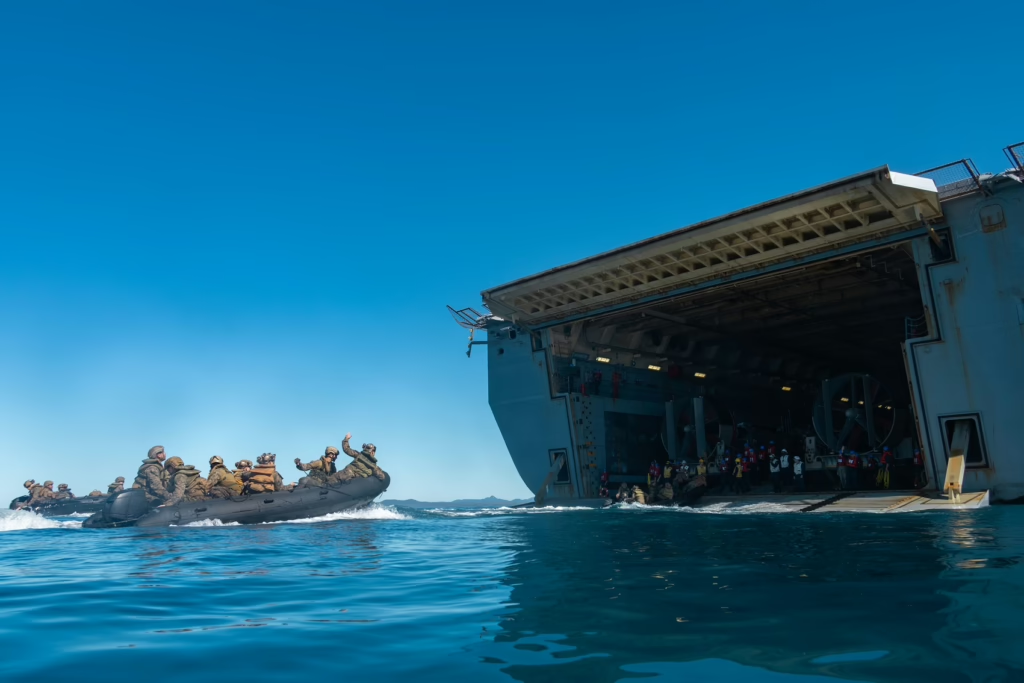

Photo caption: U.S. Marines with Baker Company, Battalion Landing Team 1st Battalion, 7th Marine Regiment, 31st Marine Expeditionary Unit, recover aboard the amphibious transport dock USS San Diego (LPD 22), during a shore-to-ship movement, utilizing the Enhanced Combat Rubber Reconnaissance Craft as a part of exercise Talisman Sabre 25, in the Coral Sea, July 14, 2025. USS San Diego was built at HII’s Ingalls Shipbuilding division and commissioned into service in 2012. (U.S. Marine Corps photo by Lance Cpl. Trevor BishopWilliams)
July 18, 2025
HII’s Weekly News Digest is compiled every Friday by the Corporate Communications team to summarize and highlight news stories of significance to the company.
House Approves Defense Appropriations Bills; Awaits Senate Action: The Hill reported on Friday that the House has approved legislation allocating roughly $832 billion in funding for defense programs for fiscal year 2026, just weeks after Republicans approved a separate $150 billion plan to advance the president’s defense priorities. Politico reported Friday that House Republicans’ first draft of annual defense funding is likely a non-starter in the Senate, where Democrats’ support is needed to pass appropriations legislation and Republicans are eyeing a boost to Trump’s Pentagon budget. Regardless, the House plan includes $36.9 billion for the Navy to purchase six new battle force ships and 22 support ships. The budget for warships includes a Columbia-class ballistic missile submarine, two Virginia-class attack subs, two Arleigh Burke-class destroyers and an ocean surveillance ship. Meanwhile, Politico reported Thursday that Senate Republicans could get their annual defense authorization bill moving as soon as next week. Inside Defense reported on Thursday that the Senate Armed Services Committee is angling to inject $5.4 billion into the Navy’s Arleigh Burke-class destroyer program and $1.2 billion into Virginia-class submarine procurement as part of its push to hike FY 2026 shipbuilding funding by over $10 billion. The committee previously announced its version of the FY 2026 defense policy bill would green light a $32 billion increase to the defense topline — led by a substantial shipbuilding boost — but programmatic funding details remained unclear until the bill text was published Wednesday. In total, the Senate bill would increase the Navy’s $20.8 billion topline shipbuilding request to nearly $31 billion.
White House Shifts Shipbuilding Oversight: Politico reported on Thursday that oversight of President Trump’s new Office of Shipbuilding has been shifted to White House Budget Director Russ Vought. Just four months after the office was created under the National Security Council, several staffers have left or been reassigned. Reuters reported on Tuesday that five of the seven Office of Shipbuilding staffers have left. That includes Ian Bennitt, the senior director for maritime and industrial capacity and who was overseeing the shipbuilding office, who left last week for the private sector. The National Security Council continues to grapple with leadership changes, major staff cuts and a loss of clout during this administration, according to Politico. The reorganization has sparked unease on Capitol Hill, where lawmakers worry reinvestment in shipbuilding is getting deprioritized. But the White House insists the move provides “enhanced focus.”
Homeland Security Cancels Offshore Patrol Cutter Contract: Defense Daily reported on Sunday that Homeland Security Secretary Kristi Noem has canceled the final two offshore patrol cutters Eastern Shipbuilding Group was contracted to build for the U.S. Coast Guard. Citing performance issues, the Coast Guard had already issued stop work orders to the Panama City, Florida-based shipbuilder and was exploring having another shipyard complete work on the two vessels. The first two ships of the four-cutter contract have been delayed for various reasons. The initial cutter is now scheduled to be delivered in the end of 2026 after the original contract called for delivery in 2021. Homeland Security said the Coast Guard’s program of record of 25 offshore patrol cutters remains intact. The Coast Guard in September 2016 awarded Eastern Shipbuilding a potential $2.4 billion contract to design and construct the first nine OPCs but two years later a severe storm forced the company to seek cost and schedule relief. In 2019, Homeland Security granted that relief but limited the contract to four ships and reopened the program to competition for hulls five through 15. In 2022, Austal USA won a potential $3.3 billion contract to build up to 11 cutters in Stage 2 of the program, beginning with hull five.
| Social Media Highlight Of The Week
Posted Wednesday to Mission Technologies’ LinkedIn page:
“Our recent industry event sparked powerful conversations about the future of defense technology. We’re continuing those discussions every Tuesday with deep dives into our mission-critical innovations with #TechTuesdays. Data-Drive Threat Analysis Scalable for Any Organization By integrating advanced security protocols and strategic defense tools, CounterMeasures is a risk management platform that enables real-time risk analysis and response to protect businesses, government entities and critical sectors. For more information, visit HII.com. |

Shifting Pentagon Policy May Accelerate Drone Acquisition, Production: Defense One reported on Friday, July 11, that Defense Secretary Pete Hegseth has told the Pentagon to treat small drones like ammunition, not airplanes, in an effort to boost production and reduce the time and effort it takes to purchase them. A memo released last week from Hegseth directs the Defense Department to treat small drones under 55 pounds — the so-called Group 1 and 2 drones — as consumables rather than “durable property.” The new policy greatly opens up who in the DoD can buy drones, how they can be bought. The changes should create a demand signal that fosters investments by U.S. dronemakers to better innovate and increase production. The memo also directs the services to treat drones like a resourced capability at the service level, allowing them to deploy congressionally allocated budgets to buy drones far more quickly. The shift comes as the DoD’s Defense Innovation Unit works with drone manufacturers to improve their craft. The New York Times reported on Sunday that DIU held and exercise last month in Alaska to help companies better prepare their products for the battlefield and to use them close the gap between existing manufacturers in China and Russia. Defense News reported on Tuesday that the DIU’s four-day testing event aims to identify — and then buy en masse — low-cost commercial uncrewed air systems that can fly at long ranges, strike enemy targets and operate through electronic warfare countermeasures like signal jamming and spoofing.
HII’s Weekly News Digest is produced by HII’s Corporate Communications team and posted to MyHII every Friday.
Please note: Social media is blocked on HII computers for most employees. Employees are encouraged to visit HII’s Facebook page and other social media sites on personal time and from non-work devices.
Send feedback to: HII_Communications@hii-co.com.