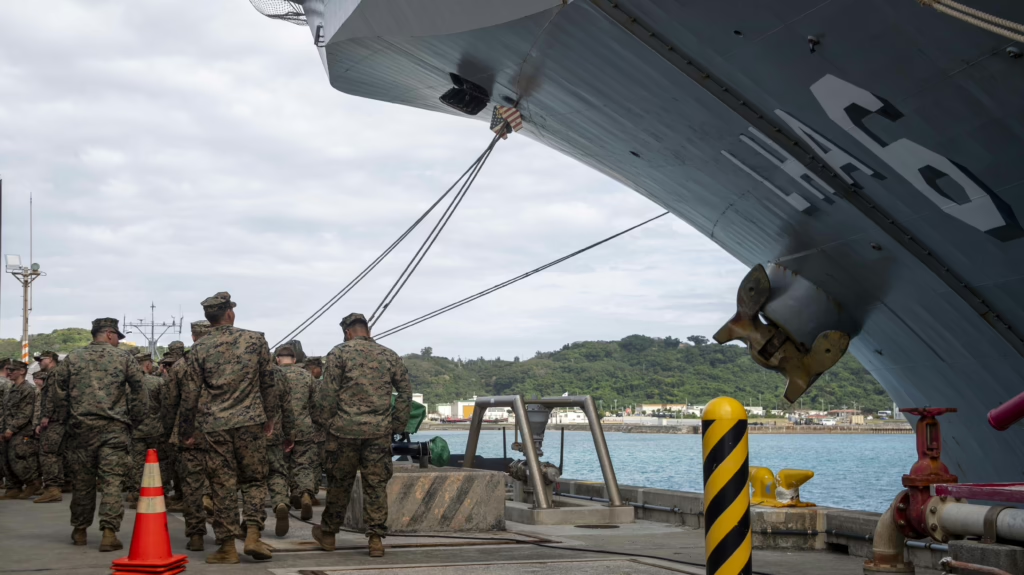

Photo caption: OKINAWA, Japan (Jan. 26, 2025) Marines assigned to the 31st Marine Expeditionary Unit (MEU) prepare to embark aboard the forward-deployed amphibious assault ship USS America (LHA 6). America was built by HII’s Ingalls Shipbuilding delivered and commissioned by the Marine Corps in 2014. (U.S. Navy photo by Mass Communication Specialist Seaman Jeadan Andre)
Jan. 31, 2025
HII’s Weekly News Digest is compiled every Friday by the Corporate Communications team to summarize and highlight news stories of significance to the company.
HII Closes On Acquisition Of Metal Fabricator: The Post and Courier reported on Tuesday that HII has completed its previously announced acquisition of the assets and facilities of metal fabrication firm W International in Goose Creek, South Carolina. The operation, now known as Newport News Shipbuilding-Charleston Operations, will include close to 500 employees who will build parts for the Navy’s nuclear-powered submarines and aircraft carriers. The acquisition will help to reduce the nearly 1.5 million hours of outsourced work the company has secured through contracts over the past couple of years. Included in the deal are 480,000 square feet of manufacturing space on 45 acres of leased land along the Cooper River. Matt Needy, the former vice president and chief transformation officer for NNS, is general manager of the site.
Congress Mulls Defense Spending Increases: Inside Defense reported on Wednesday that lawmakers and Navy officials expect the Trump administration to amend the fiscal year 2026 defense budget request before it is submitted to Congress, likely increasing both topline spending levels and funding for shipbuilding programs. Talks among congressional tastemakers indicates a following sea for shipbuilding funds. Speaking during the WEST 2025 conference, Rep. Joe Courtney, D-Conn., pointed to efforts from Senate Armed Services Committee Chairman Roger Wicker, R-Miss., and other lawmakers to substantially increase defense spending through a budget reconciliation package. Courtney indicated this package and other congressional actions, such a as vote to increase the debt ceiling, could spill over into FY 2026 budget negotiations. Breaking Defense reported on Monday that Wicker is pushing for a $200 billion increase in defense spending spread over the next two years, aiming to fund priorities including an Iron Dome-style missile defense system as well as investments in areas such as shipbuilding, submarines and the Air Force’s next-generation fighter. Meanwhile, Politico reported on Wednesday that as lawmakers shape the next budget, Republicans are balancing deep spending cuts with a defense spending boost, setting the stage for a high-stakes negotiation. With competing priorities, the budget process is expected to be a complex battle over funding levels and policy trade-offs.
General Dynamics’ Q4 Earnings Slowed By Submarine Supply Chain: Defense Daily reported on Wednesday that General Dynamics reported a drop in operating earnings at the company’s Marine Systems segment during the fourth quarter due to ongoing delays and quality issues with the submarine supply chain. Delays continue to result in “out of sequence work,” and quality problems have mounted that “further disrupted our build plan,” with both issues adding costs, said Phebe Novakovic, GD’s chairwoman and CEO, during Wednesday earnings call. The company also reported some material costs rose 37% higher than expected, offsetting higher sales in the company’s shipbuilding business. Novakovic noted during the call that while the continuing resolution funding the government into March contains some Columbia class and Virginia class submarine funding, there are still budget holes that need to be addressed in the programs that require additional funding. Reuters reported on Wednesday that GD listed fourth quarter net earnings for the whole company at $1.1 billion, and it earned $3.8 billion for the entire year. For 2025, General Dynamics forecast a total revenue of $50.3 billion, compared with 2024 revenue of $47.7 billion.
| Social Media Highlight Of The Week
Posted Thursday on Ingalls Shipbuilding’s LinkedIn page:
“HII’s #IngallsShipbuilding division along with representatives from the U.S. Navy, Accelerate Mississippi and Mississippi Gulf Coast Community College (MGCCC), celebrated the opening of a virtual reality (VR) welding lab at the shipyard Wednesday. The new facility makes it easier and safer for welders to hone their skills, and enhance HII’s ability to grow the number of proficient shipbuilders with this essential skillset. Read the news release here: https://hii.com/news/hiis-ingalls-shipbuilding-opens-new-virtual-reality-welding-lab/.” |
HII Begins Fabrication On Latest Amphib: The Defense Post reported on Thursday that HII’s Ingalls Shipbuilding division has begun construction of the 16th San Antonio-class amphibious transport dock vessel in Pascagoula, Mississippi. HII announced the start of fabrication on Wednesday of Philadelphia (LPD 32), meaning the first 100 tons of steel for the ship’s hull have been cut. Philadelphia is the third San Antonio-class ship to be built in the program’s Flight II configuration, which incorporates more cost-effective parts and about 200 upgrades to the overall design compared to older ships. Naval Technology reported on Thursday that LPD Flight II ships are designed to be the next generation of amphibious vessels, set to replace the older Whidbey Island (LSD 41) and Harpers Ferry (LSD 49) classes. LPDs are deployed alongside a Marine Corps Air-Ground Task Force for a range of operations from deterrence and joint-force enablement to humanitarian assistance and disaster relief.
Future Fights Require More Realistic Training: USNI News reported on Thursday that operational commanders believe the Marine Corps and Navy need to keep investing in realistic training simulators, multi-domain integrated exercises, more lethality and advanced technologies that keep up with new threats to better prepare Marines and sailors for future high-end fights. Those commanders said training systems must have the ability to adapt and adjust to the latest threats. The Marine Corps’ three expeditionary forces already have started training and preparing their operational units, including stand-in forces that would fight within the weapons engagement zone. These revamped unit training and large-scale service training exercises incorporate current and future threats and also provide more naval integration and more live-virtual-constructive events with high-fidelity systems that connect live units at different locations ashore and at sea. “As we partner with industry and look to the future of LVC, we’ve got to make it more plug-and-play, able to adapt and be able to spiral in new sensors, new software, firmware and hardware, because it makes it hard for those young sailors when they’re trying to get their reps and sets,” said Vice Adm. John Wade, the U.S. Third Fleet commander in San Diego, during a panel discussion at WEST 2025.
HII’s Weekly News Digest is produced by HII’s Corporate Communications team and posted to Homeport every Friday.
Please note: Social media is blocked on HII computers for most employees. Employees are encouraged to visit HII’s Facebook page and other social media sites on personal time and from non-work devices.
Send feedback to: HII_Communications@hii-co.com.