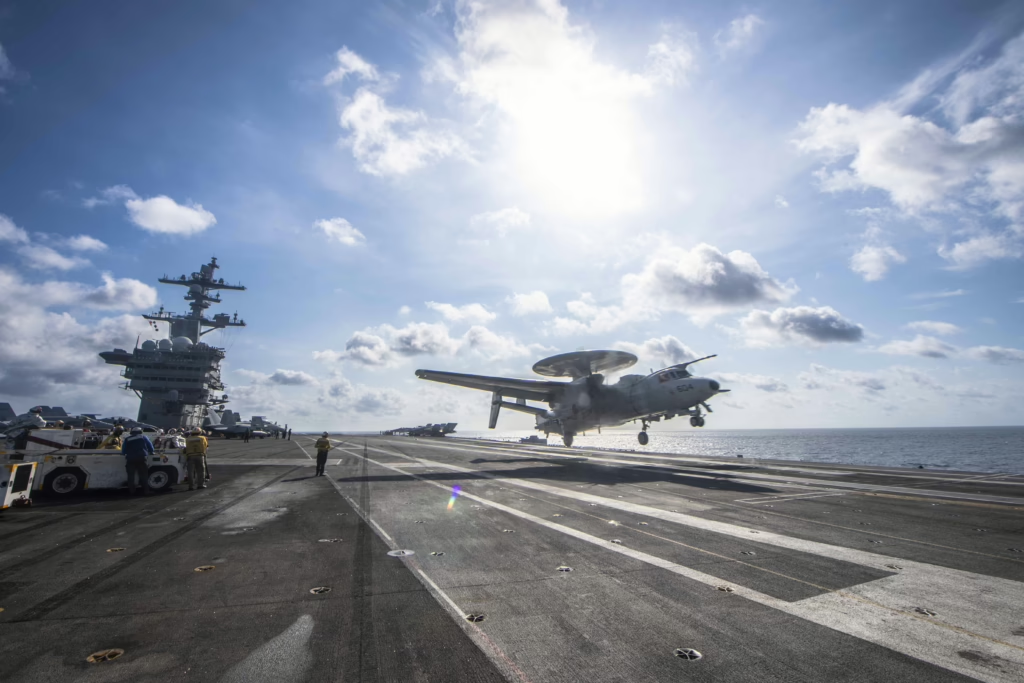

Photo caption: SOUTH CHINA SEA (Jan. 3, 2025) An E-2D Advanced Hawkeye assigned to the “Black Eagles” of Carrier Airborne Early Warning Squadron (VAW) 113 launches from the flight deck of the Nimitz-class aircraft carrier USS Carl Vinson (CVN 70), on Jan. 3, 2025. Vinson, the flagship of Carrier Strike Group ONE, is underway conducting routine operations in the U.S. 7th Fleet area of operations. (U.S. Navy photo by Mass Communication Specialist 3rd Class Nate Jordan)
Jan. 3, 2025
HII’s Weekly News Digest is compiled every Friday by the Corporate Communications team to summarize and highlight news stories of significance to the company.
HII Guides Australian Companies Into AUKUS Supply Chain: The Washington Post reported on Wednesday that HII is running a pilot program in South Australia that is bringing local companies into the U.S. nuclear submarine supply chain. Michael Lempke, who leads HII’s AUKUS efforts, told the Post that the company will soon launch a similar program in Western Australia. The effort aims to speed up U.S. submarine production and prepare Australia to maintain its Virginia-class vessels and, eventually, to build the country’s own nuclear-powered submarines. AUKUS efforts are well underway, both in Australia and abroad. The Australian state government is boosting STEM — science, technology, engineering and mathematics — education in its elementary schools, including lessons that could lead to AUKUS-related careers. Scores of Australian shipbuilders are in Pearl Harbor training on American subs ahead of rotations of United States and United Kingdom boats to Western Australia starting in 2027. Australia is spending $5 billion on upgrading a naval base in Perth ahead of the submarine visits. Nearly 60 members of the Royal Australian Navy are training to work on nuclear-powered submarines in the United States or the United Kingdom, according to Australian defense officials, and nearly a dozen are already serving on U.S. or U.K. subs. The Guardian reported on Dec. 23 that the Australian Navy is leading a recruiting drive for nuclear submarine officers. All of these efforts are to prepare Australia for when it buys the first of at least three U.S. Virginia-class submarines around 2032. That’s also around the time Australia will begin building the first of five nuclear-propelled submarines in Adelaide.
Biden Formally Blocks Purchase Of US Steel: The Wall Street Journal reported on Friday that President Joe Biden has blocked Nippon Steel’s proposed $14.9 billion purchase of U.S. Steel. NBC News reported Friday that Biden cited national security as his chief concern in his decision. “A strong domestically owned and operated steel industry represents an essential national security priority and is critical for resilient supply chains,” wrote Biden in a statement. Biden’s decision comes less than a week after Japanese-owned Nippon Steel proposed giving the U.S. government a veto over any reduction in U.S. Steel’s “production capacity.” The offer was seen as a concession to help sway the president’s approval of the deal. Reuters reported on Tuesday that the Committee on Foreign Investment in the United States (CFIUS) referred the decision to approve or block the Nippon’s takeover last week to Biden after the group deadlocked on a decision. Biden is siding with David McCall, the president of the United Steelworkers union, who has blasted Nippon Steel’s bid as “bad for workers” and who questioned the company’s commitment to U.S. Steel’s unionized operations. The Washington Post reported on Friday that Nippon Steel and U.S. Steel have vowed to pursue legal action against the government, claiming it failed to follow proper procedures during its consideration of the acquisition.
Hanwha Completes Philly Shipyard Purchase: GovCon Wire reported on Dec. 23 that South Korea-based Hanwha Systems and Hanwha Ocean have closed their acquisition of U.S. shipbuilder Philly Shipyard for approximately $100 million. David Kim, most recently executive vice president for Hanwha Defense USA, has been appointed CEO of the acquired company, which will operate as Hanwha Philly Shipyard. In June, Hanwha agreed to acquire the U.S. shipbuilder from Norway-based Philly Shipyard ASA, which is majority owned by Norwegian industrial investment company Aker ASA. Founded in 1997, Philly Shipyard constructs training vessels for the U.S. Maritime Administration, or MARAD. The company recently completed the second National Security Multi-Mission Vessel for MARAD. Since 2000, the company has supplied about 50 percent of all large U.S. Jones Act-compliant commercial vessels, including tankers and container ships. Hanwha Systems develops radars and sensors for manned-unmanned teaming, or MUM-T, operations, maintenance, repair and overhaul platforms for naval combat systems and technologies for unmanned maritime systems.
| Social Media Highlight Of The Week
Posted Monday on HII’s Facebook page:
“Did you know that approximately half of all Ingalls shipbuilders build amphibious ships today, with another 650 supplier partners in 39 states across the country that provide components for the construction of amphibious ships? In September, HII announced that our #IngallsShipbuilding division was awarded a multi-ship procurement contract for the construction of three San Antonio-class (#LPD17) amphibious ships and a contract modification for the next America-class (#LHA6) large-deck amphibious ship. This combined procurement is a first of its kind for amphibious ships! None of this would be possible without the hard work of our Ingalls shipbuilders and their support of HII’s commitment to supporting the joint U.S. Navy and U.S. Marine Corps team. Great work, shipbuilders! Read more at: https://hii.com/news/hii-is-awarded-amphibious-multi-ship-procurement-contracts/. ” |
Deal Surge Predicted In Defense Industry: The Financial Times reported on Monday that defense companies are primed for a surge in deal activity over the next few years as many look to deploy growing cash piles to invest in technologies such as artificial intelligence, sophisticated drones and space systems. The leading 15 defense contractors are forecast to log free cash flow of about $50 billion in 2026, according to an analysis by Vertical Research Partners for the Financial Times — almost double their combined cash flow at the end of 2021. Michael Sion, partner at consultants Bain & Co, said he expected a pick-up in aerospace and defense merger and acquisition activity, and forecast an influx of funding from private equity and venture capital firms. Sion also noted that given the modernization needs of the defense industry, an opportunity exists for private capital to play a larger role. Private capital, he said, could help to plug a “funding gap” between U.S. defense requirements and defense budgets.
DOD Considers Program To Increase Payments To Subcontractors: Inside Defense reported on Monday that the Pentagon is seeking industry input on a proposal that would increase the customary progress payment rate on approved Defense Department contracts by up to 10%. A Federal Register notice published Monday notes that the changes to the Progress Payment Incentive Pilot (PPIP) on the timing of payments to subcontractors would “improve cash flow throughout the supply base.” The Pentagon plans to structure the progress payment incentive in two pillars — one at which the subcontractor can earn 10% more, and one where the subcontractor can earn 5% more. The deadline to respond to the DOD’s request for information is Jan. 29.
HII’s Weekly News Digest is produced by HII’s Corporate Communications team and posted to Homeport every Friday.
Please note: Social media is blocked on HII computers for most employees. Employees are encouraged to visit HII’s Facebook page and other social media sites on personal time and from non-work devices.
Send feedback to: HII_Communications@hii-co.com.