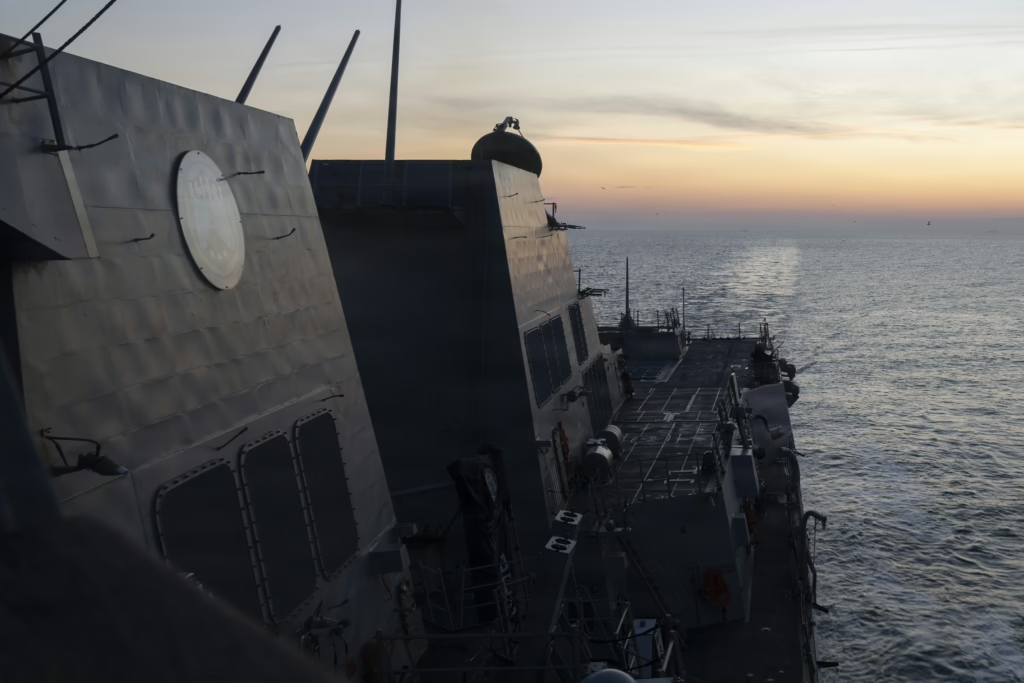

Photo caption: YORKTOWN, Va. (Jan. 5, 2026) – Arleigh Burke-class guided-missile destroyer USS Delbert D. Black (DDG 119) prepares to approaches Naval Weapon Station during a regularly scheduled deployment. HII’s Ingalls Shipbuilding division delivered DDG 119 to the U.S. Navy in 2020. (U.S. Navy photo by Mass Communication Specialist 1st Class Wendy Arauz)
Jan. 16, 2026
HII’s Weekly News Digest is compiled every Friday by the Corporate Communications team to summarize and highlight news stories of significance to the company.
HII Expands UK Unmanned Facility: Breaking Defense reported on Tuesday that HII has doubled the size of its unmanned systems facility in Portchester, England, expanding support for United Kingdom and European REMUS unmanned underwater system (UUV) operators. The expansion adds about 6,500 square feet and increases capacity for REMUS 620 support, training and autonomy integration, including work tied to the ROMULUS unmanned surface vessel (USV) program. UK Defence Journal reported on Tuesday that the site is expected to grow from seven employees to as many as 17 as activity increases. The facility will serve as HII’s primary European hub for uncrewed systems sustainment, reinforcing long-standing Royal Navy use of REMUS UUVs for mine countermeasures. The expansion also supports ongoing work involving torpedo tube launch and recovery of REMUS 620 vehicles in partnership with the U.K. firm Babcock. The facility is expected to serve growing demand from customers as navies move from limited trials to fleet-level adoption. Demand also continues to rise, in part, because of the modular design of HII’s unmanned systems, which allows payloads and onboard technology to be upgraded over time, extending service life and reducing the need for wholesale replacement.
HII Demonstrates Autonomous Maritime Capability With Sea Launcher: Maritime Executive reported on Tuesday that HII has developed an automated system, known as Sea Launcher, that allows unmanned surface vessels to autonomously launch and recover REMUS unmanned underwater vehicles (UUVs) without human intervention. Naval Technology reported on Wednesday that HII completed a shipboard demonstration of the Sea Launcher system under operationally relevant conditions. The test validated a fully autonomous launch and recovery sequence aligned with procedures already used by the U.S. Navy and allied forces. NextGenDefense reported on Thursday that Sea Launcher successfully managed the entire mission cycle, from deployment to retrieval, without any manual intervention. By automating launch and recovery, the tool reduces risk to crews, shortens time on deck, and allows ships to operate more safely in rough seas or riskier environments.
HII Included On $151 Billion SHIELD Contract: The Defense Post reported on Wednesday that HII has been awarded a contract to provide services for the U.S. Missile Defense Agency’s Scalable Homeland Innovative Enterprise Layered Defense (SHIELD) contracting vehicle. SHIELD is leading the acquisition effort intended to help the Pentagon materialize its planned Golden Dome system, a network of radars and interceptors designed to protect the continental U.S. against modern air and missile threats. Procurements under this strategy have a ceiling of $151 billion, with more than 2,000 industry partners selected to support the development, testing and fielding of corresponding technologies. ExecutiveBiz reported on Wednesday that the contract positions HII to deliver technologies supporting data and cyber operations, directed energy, integrated command and control, microelectronics, spectrum management, logistics, sustainment, and live, virtual and constructive training environments.
CNO: Defense Spending Should Be Lifted Above 4% GDP: Breaking Defense reported on Wednesday that Chief of Naval Operations Adm. Daryl Caudle believes U.S. defense spending needs to be permanently adjusted to at least 4% of the nation’s gross domestic product, or a baseline of roughly $1.25 trillion. The U.S. defense budget currently approaches $1 trillion, about 3.3% of GDP. The spending growth would enable the Navy to meet current readiness demands and to expand its fleet to contend with future threats. Caudle told participants at the Surface Navy Association’s annual conference this week that the adjustment should be a “new normal.” President Donald Trump recently suggested the country pump an additional $500 billion into the fiscal year 2027 defense budget which would make the defense budget about 5% GDP. Defense Daily reported Wednesday that Caudle believes that consistent investment over 4% GDP would allow the Navy to move from its current size of about 300 ships to the congressionally validated requirement of 355 ships.
| Social Media Highlight Of The Week
Posted Wednesday on HII’s Facebook page:
“HII kicked off the 38th Surface Navy Association National Symposium by connecting with U.S. Navy leaders, industry partners, and stakeholders to discuss the future of surface warfare. We were honored to welcome Congressman Mike Ezell from Mississippi, Under Secretary of the Navy Hung Cao, and many more to the HII booth on Tuesday. Stop by Booth 1002 to learn how HII is building and delivering capability, speed, and advantage to the fleet. #SNA2026 #DeliveringTheAdvantage” |

Proposed Battleship Born Out Of DDG(X) Limitations: Breaking Defense reported on Tuesday that Navy leaders were deciding how to best arm the next generation of Arleigh Burke-class destroyers when the idea for developing a larger battleship came about. Rear Adm. Derek Trinque told participants at the Surface Navy Association’s annual conference that size limitations of the planned DDG(X) destroyer would have forced Navy leaders to decide whether to arm the ship with a gun weapon system or a soon-to-be fielded hypersonic weapon system, Trinque said. Instead, the 30,000-ton battleship will include hypersonic weapon system, gun weapon systems, vertical launch systems, power for directed energy weapons — an “incredible amount of offensive strike capability” as well as command-and-control capacity that the Navy does not have in its current fleet, he said. Inside Defense reported on Tuesday that HII CEO Chris Kastner told reporters during a roundtable discussion that the company will learn more about the battleship design over the next 30 to 60 days. Key details are still being made public. DefenseScoop reported on Wednesday that the ship will not be nuclear powered, and Inside Defense reported on Thursday that the lead ship is expected to cost upward of $21 billion.
HII’s Weekly News Digest is produced by HII’s Corporate Communications team and posted to Homeport every Friday.
Please note: Social media is blocked on HII computers for most employees. Employees are encouraged to visit HII’s Facebook page and other social media sites on personal time and from non-work devices.
Send feedback to: HII_Communications@hii-co.com.