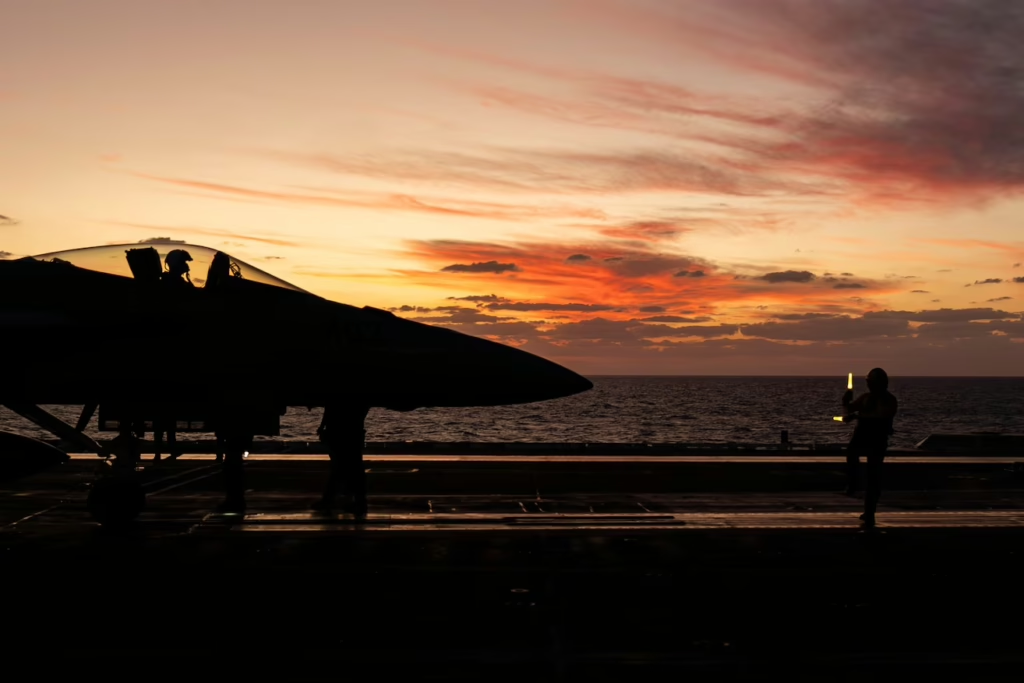

Photo caption: A U.S. Navy aviation boatswain’s mate (aircraft handling) directs an F/A-18E Super Hornet from Strike Fighter Squadron (VFA) 136 aboard the Nimitz-class aircraft carrier USS Harry S. Truman (CVN 75) in the U.S. Central Command area of responsibility. Christened in 1996 and delivered to the Navy in 1998, USS Harry S. Truman will be the eighth Nimitz-class carrier to undergo a midlife overhaul at NNS.(U.S. Navy photo)
Jan. 10, 2025
HII’s Weekly News Digest is compiled every Friday by the Corporate Communications team to summarize and highlight news stories of significance to the company.
Submarine Funding Anomaly Falls Short: USNI News reported on Thursday that the anomaly for submarines in the current federal stopgap spending bill isn’t enough to get the boats the Navy wants under contract, HII CEO Chris Kastner said. Kastner told reporters that the $5.6 billion in the current continuing resolution allotted for the Virginia-class submarines doesn’t solve all of the challenges facing companies building nuclear-powered ships. HII and General Dynamics Electric Boat are still negotiating with the Navy to ink a deal on 17 planned boats, including two fiscal year 2024 Virginia-class submarines and multi-year procurement contracts for 10 Block VI Virginia-class boats and five Build II Columbia-class ballistic missile submarines. Inside Defense reported on Thursday that Kastner believes inking the 17-sub deal will required a solution that closely resembles the proposed Shipbuilder Accountability and Workforce Support (SAWS) agreement. “I think there is an opportunity with the new administration. I think there’s probably more receptivity to innovation in contracting and that could potentially support getting these 17 boats under contract,” Kastner said. “And (SAWS) is an innovative approach that increases wages, accelerates submarine production, reduces the cost through the (future years defense program). It really checks all the boxes relative to how you want to get boats under contract.”
CBO: Shipbuilding Costs On The Rise: Inside Defense reported on Monday that the Congressional Budget Office has published a report stating total shipbuilding costs for the U.S. Navy over the next 30 years could average $40 billion per year — 17% more than the service estimated — largely due to cost growth among various programs. The 2025 shipbuilding plan released last March focuses on achieving a fleet of 381 manned ships, a target established a 2023 Navy assessment formally called the Battle Force Ship Assessment and Requirement report. To implement the shipbuilding plan, the Navy’s budget would need to increase from $255 billion to $340 billion in fiscal year 2024 dollars, according to the CBO report. The annual $40 billion in shipbuilding costs between 2025 and 2054 includes $35.8 billion for new ship construction per year. USNI News reported on Tuesday that across the scope of the service’s 30-year plan, the Navy is set to grow from its current battle force of 296 manned ships to 381 manned vessels plus 134 unmanned surface and subsurface vehicles by 2045, according to the service’s latest fleet structure review presented to Congress. Overall, the net addition of 85 ships to the fleet would cost the Navy $1 trillion, according to the CBO analysis.
Wicker Unveils Acquisition Improvement Proposal: Defense Daily reported on Monday that Senate Armed Service Committee Chairman Roger Wicker, R-Miss., had unveiled a wide-ranging proposal for improving the Pentagon’s acquisition process, to include “aggressively” cutting regulations, reducing reliance on cost-plus contracts and implementing budgeting reform. Wicker also released a legislative proposal that includes many of the reforms in his new “Restoring Freedom’s Forge: American Innovation Unleashed” report, outlining many of the priorities he’s likely to pursue as he takes the gavel of the defense oversight committee. The reported includes DOD acquisition reform recommendations across five areas, to include cutting red tape, unleashing innovation, increasing competition, enabling decisive action and modernizing the budget process.
| Social Media Highlight Of The Week
Posted Thursday on HII’s LinkedIn page:
“We are proud that HII’s CEO, Chris Kastner, has been named to the Business Roundtable Board of Directors and will serve as Chair of the Education and Workforce Committee. This selection reflects Chris’s unwavering commitment to advancing innovative solutions for workforce development and education—key pillars in empowering individuals, strengthening communities, and advancing the nation’s economic competitiveness.” |

Trump: US Will Lean On Allies To Build Ships: Politico reported on Monday that President-elect Donald Trump has suggested the U.S. may rely on allies, such as South Korea and Japan, to build U.S. Navy ships, citing delays in domestic shipbuilding and a need to counter China’s rapidly growing fleet. This marks a potential departure from Trump’s earlier “Buy American” policies and has raised concerns among U.S. domestic labor advocates. Defense Daily reported on Tuesday that while Trump hasn’t been specific about his plans, it could continue along a path taken by the Biden administration. Navy Secretary Carlos Del Toro has focused on securing foreign investments to revitalize U.S. shipyards, including a deal he helped broker allowing South Korea’s Hanwha to buy Philly Shipyard. Del Toro has sought similar collaborations with Danish and Japanese firms.
Special Operators Seek Security Through Obscurity: Defense Scoop reported on Wednesday that U.S. special operations forces are honing their ability to achieve obscurity on hyper-transparent battlefields, now that the adversaries are more easily obtaining intelligence, surveillance and reconnaissance capabilities tools. To counter those technological advances, U.S. special operations forces need to hone their ability to achieve “security through obscurity,” said Christopher Maier, assistant secretary of defense for special operations and low-intensity conflict. That means operators must learn to alter their footprints in the digital environment in ways that won’t attract the interest of adversaries. Maier said his department is experimenting with layered approaches to obscuring digital footprints in hyper-transparent battlefields. Last month, U.S. Special Operations Command released a new strategy document, dubbed “SOF Renaissance,” which notes that special ops forces must be early adopters at the Defense Department of innovations in areas such as artificial intelligence, autonomous systems and cyber to enhance irregular warfare capabilities in complex operating environments.
HII’s Weekly News Digest is produced by HII’s Corporate Communications team and posted to Homeport every Friday.
Please note: Social media is blocked on HII computers for most employees. Employees are encouraged to visit HII’s Facebook page and other social media sites on personal time and from non-work devices.
Send feedback to: HII_Communications@hii-co.com.