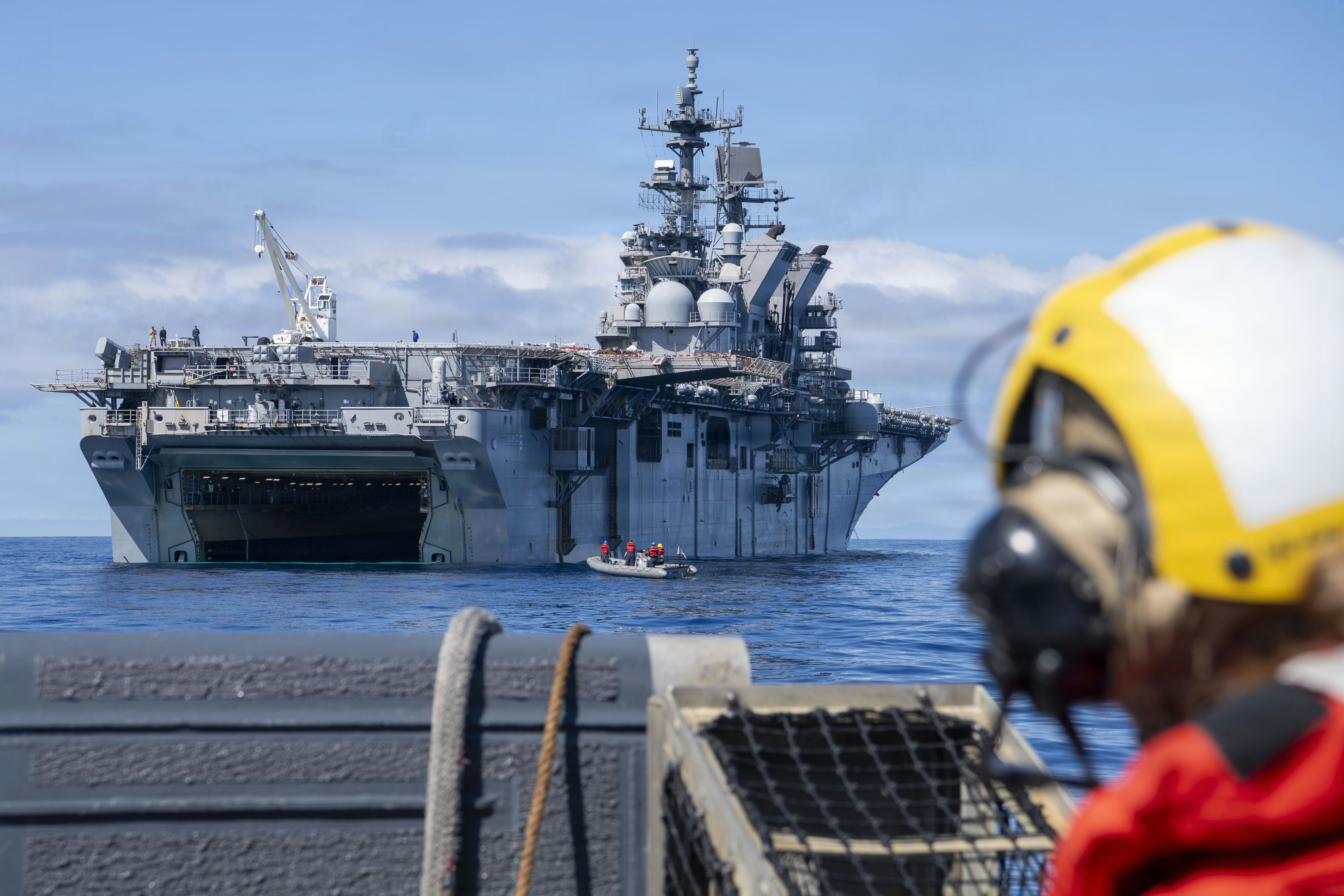
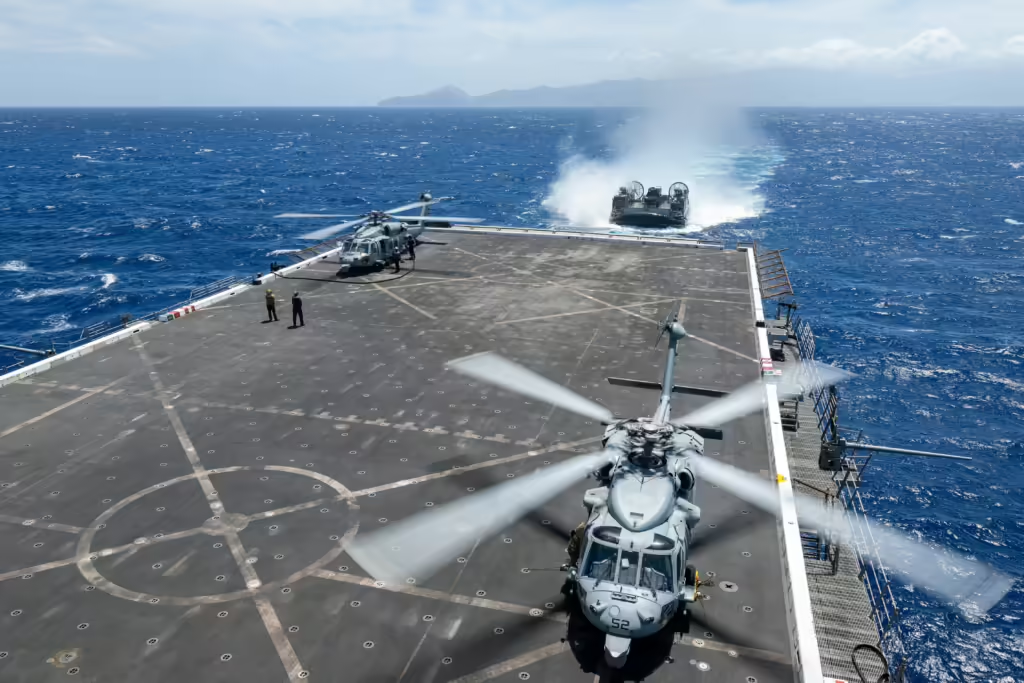

Photo caption: Sailors aboard the San Antonio-class amphibious transport dock ship USS Somerset (LPD 25) monitor MH-60S Sea Hawk helicopters assigned to the “Wildcards” of Helicopter Sea Combat Squadron (HSC) 23 as a landing craft, air cushion (LCAC) from Assault Craft Unit (ACU) 5 approaches the well deck during Exercise Rim of the Pacific (RIMPAC) 2024 while underway in the Pacific Ocean, July 24, 2024. USS Somerset was built by HII’s Ingalls Shipbuilding division and commissioned by the U.S. Navy in March 2014. (U.S. Navy photo by Mass Communication Specialist 2nd Class Evan Diaz)
Aug. 16, 2024
HII’s Weekly News Digest is compiled every Friday by the Corporate Communications team to summarize and highlight news stories of significance to the company.
Navy Greenlights Multiyear $11.5 Billion Amphib Purchase: Politico reported on Thursday that the U.S. Navy has agreed to a multiyear purchase of four amphibious vessels from HII. The $11.5 billion deal is expected to be signed next month, according to Sen. Roger Wicker, the Senate Armed Services Committee’s top Republican. Navy Secretary Carlos Del Toro also notified Congress Wednesday of the imminent deal for three San Antonio-class amphibious transport docks and one America-class amphibious assault ship over the next five years, according to the congressional notice obtained by Politico. Breaking Defense reported on Thursday that the multiyear purchase will save taxpayers $901 million and offer steady work to HII’s Ingalls Shipbuilding division. USNI News reported on Thursday that information provided to Congress by the Navy notes LPD 33 would be procured in fiscal year 2025 for an estimated $2.2 billion, LPD 34 in FY 2027 for $2.3 billion and LPD 35 in FY 2029 for $2.4 billion. The deal would also purchase Flight I America-class big deck, Helmand Province (LHA 10), in FY 2027 for $4.6 billion.
Mission Technologies Wins $209 Million Air Force Contract: WashingtonExec reported on Tuesday that HII’s Mission Technologies division will perform research and analysis to support the U.S. Air Force’s weapons systems development, sustainment and long-term strategy under a new $209 million contract. Under the five-year task order, HII will help the Air Force Fighters and Advanced Aircraft and Bomber Directorates’ efforts to provide the Air Force, other U.S. military branches and partner nations with fighter and bomber weapons systems that operate across various warfighting scenarios, the company said. The Defense Post reported on Tuesday that the award comes after a string of announcements in which HII has won Air Force contracts. Those include a January award in which HII will produce a Joint Training Synthetic Environment for Air Force combatant commands. In August 2023, HII accepted a $148 million recompete task order to deliver professional services for the bomber fleets under the Air Force Life Cycle Management Center Bombers Directorate.
AUKUS Clears Significant Export Control Hurdle: Reuters reported on Thursday that the U.S. State Department has informed Congress that Australia, Britain and the United States now have comparable export-control regimes, a significant step needed to facilitate technology sharing and allow the trilateral AUKUS defense pact to move ahead. The countries plan to share closely guarded technology, which is governed by strict U.S. International Trafficking in Arms Regulations (ITAR). The 2024 U.S. National Defense Authorization Act required President Joe Biden to determine whether Australia and Britain have export control regimes “comparable to the United States” and thereby qualify for ITAR exemptions. Breaking Defense reported on Thursday that the reformed rules are expected to go into effect Sept. 1. While nuclear technology is not governed by ITAR, many of the components and systems on the two Virginia-class subs Australia is expected to buy are covered. The reforms should also aid in speeding some exports for the non-submarine, tech-focused AUKUS Pillar II initiative. Defense News reported on Thursday that Australia and the U.K. are making similar legislative updates. In a statement, the U.K. said the exemptions will span $643 million of its annual defense exports. Australia’s government said it would end the need for 900 permits required to export goods to the U.S. and U.K. — covering a value of $5 billion annually.
| Social Media Highlight Of The Week
Posted Wednesday on Mission Technologies’ LinkedIn page: “We are looking forward to seeing you at our booth at TechNet Augusta, Aug. 19-22 at the Augusta Marriott Convention Center in Georgia. Learn more about the rest of our Cyber, EW and Space portfolio: https://hii.com/what-we-do/capabilities/cyber-ew-space/.” |

Navy Deadline To Have 75 Mission Capable Ships Approaches: USNI News reported on Tuesday that the U.S. Navy’s Surface Warfare Office is working vigilantly to meet its Sept. 30 deadline to have 75 of its warships as mission capable and prepared to deploy at any time. The Navy is 18 months into its two-year plan that ultimately tries to improve maintenance and sustain ship readiness by predicting maintenance issues and dealing with emergent problems. Navy officials are using artificial intelligence and machine learning to predict what shipboard parts will likely break and to identify what regular maintenance actions are needed to avert trouble at sea. Vice Adm. Brendan McLane, the Naval Surface Forces commander, did not say how close the Navy is to its 75-ship goal. Meanwhile, USNI News published the Report to Congress on the U.S. Navy Force Structure, Shipbuilding, on Wednesday. The Navy projects that 10 new ships will be delivered to the fleet in fiscal year 2025. The Navy’s FY 2025 budget proposes retiring 19 existing ships, including 10 ships that would be retired before reaching the ends of their expected service lives.
Austal Shifts Gears To Submarine Work: Inside Defense reported on Thursday that Austal plans to become a primary partner for General Dynamics Electric Boat, helping build components for Virginia– and Columbia-class submarines. Austal’s contracted work building the Navy’s littoral combat ships and expeditionary fast transports at the company’s Alabama facility is nearing completion. Now, Austal is partnering with EB to build modules for both submarine programs. Larry Ryder, Austal USA’s vice president for business development and external affairs, said Austal, Electric Boat and the Navy are finalizing the design for a new submarine module assembly facility at the Mobile, Alabama, yard that is likely to require an investment of $300 million to $400 million to construct. Even without the new facility, submarine work is underway. Once submarine modules are completed at Austal, they will be loaded onto a barge and shipped up the East Coast to Electric Boat’s facilities in Connecticut and Rhode Island. Austal has already developed a similar relationship with HII’s Newport News Shipbuilding division, constructing the elevators for Ford-class aircraft carriers Enterprise (CVN 80) and Doris Miller (CVN 81).
HII’s Weekly News Digest is produced by HII’s Corporate Communications team and posted to Homeport every Friday.
Please note: Social media is blocked on HII computers for most employees. Employees are encouraged to visit HII’s Facebook page and other social media sites on personal time and from non-work devices.
Send feedback to: HII_Communications@hii-co.com.