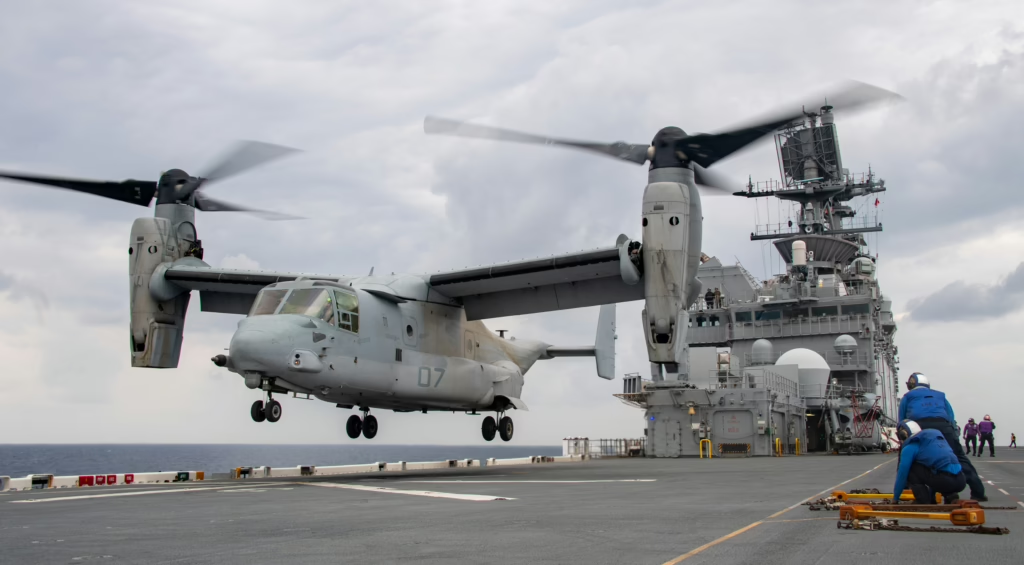

Photo caption: PHILIPPINE SEA (Jan. 23, 2025) An MV-22B Osprey tiltrotor aircraft lands on the flight deck of the forward-deployed amphibious assault ship USS America (LHA 6) while conducting flight operations. America, lead ship of the America Amphibious Ready Group, is operating in the U.S. 7th Fleet area of operations. The amphibious assault ship was built by HII’s Ingalls Shipbuilding division. (U.S. Navy photo by Mass Communication Specialist Seaman Kenneth Melseth)
Jan. 24, 2025
HII’s Weekly News Digest is compiled every Friday by the Corporate Communications team to summarize and highlight news stories of significance to the company.
Flight IIA Destroyers Taking On Additional Carrier Strike Group Responsibilities: The WarZone reported on Monday that Flight IIA Arleigh Burke-class destroyers will increasingly serve as the air defense commander in carrier strike groups that has long been a role by the aging Ticonderoga-class cruiser fleet. While Flight III DDGs will one day take over the air defense commander mission — as they were designed specifically to do — they are still coming online. The Navy is also retiring the aging cruiser fleet, creating a gap that can be served by Flight IIA destroyers. A warship serving as a CSG air defense commander is responsible for tracking objects in the sky for the strike group, and coordinating actions across the group to investigate and, if need be, neutralize those threats. They are the nerve center of the air warfare fight and have the ability to use all the air defense assets in the group to achieve their objectives. The cruisers traditionally undertaking such missions have a larger Combat Information Center (CIC) with more watch standers, as well as expanded hardware. Advances in destroyer hardware and the ever-evolving Aegis Combat System mean that the Flight IIAs are up to taking over the task as the Navy intends. USNI News reported on Jan. 16 that several Flight IIA destroyers are in line to receive all electronic warfare, radar and combat system upgrades under the service’s $17 billion Destroyer Modernization 2.0 program. The program aims to bring the Flight IIA destroyers up to capabilities similar to Flight III destroyers.
$100 Billion Joint Venture To Boost US Artificial Intelligence Efforts: Defense One reported on Wednesday that Oracle, OpenAI, and investors in Japan and the United Arab Emirates have launched a $100 billion effort to build out data centers and the electricity generation needed for the further development of the fast-evolving artificial intelligence in Texas. The Associated Press reported on Wednesday that the initial $100 billion investment could reach five times that sum over the next four years. The venture, known as Stargate, is being operated by generative AI company OpenAI, which will be the primary user of the data centers. Oracle has already begun building 10 data centers in Texas for the project, CEO Larry Ellison said Tuesday at a White House press conference. OpenAI has long relied on Microsoft data centers to build its AI systems, but it has increasingly signaled an interest in building its own data centers. CBS News reported on Wednesday that other investors are expected to join the venture, although it was not immediately clear which ones.
Navy Seeks Intelligence, Surveillance, and Reconnaissance Assistance: Defense Scoop reported on Wednesday that Naval Air Systems Command’s program executive office for unmanned aviation and strike weapons wants to onboard additional companies that can support intelligence, surveillance and reconnaissance (ISR) missions via contractor-owned, contractor-operated (COCO) drones and sensors. Existing deals with Insitu and Textron System to provide these services under basic ordering agreements are set to expire next year, according to a request for information published Tuesday on Sam.gov. The RFI comes as the Navy and Marine Corps — and the Defense Department writ large — continue to see an increase in demand for drones and intelligence, surveillance and reconnaissance capabilities. Procuring COCO ISR services is a way for the military to augment its capacity without having to buy and maintain additional systems and manage their full lifecycles.
Boeing Warns of Significant Fourth Quarter Losses: The Wall Street Journal reported on Thursday that Boeing lost roughly $4 billion in the fourth quarter of 2024, when the jet maker was hit by a debilitating strike, suffered mounting losses in troubled U.S. government projects and incurred costs tied to sweeping job cuts rolled out at the end of the year. Boeing warned investors on Thursday that it generated less revenue and racked up bigger losses than Wall Street anticipated. The company is scheduled to release its full results on Tuesday. Breaking Defense reported on Thursday that $1.7 billion of Boeing’s losses come from several defense programs, including an $800 million loss on the KC-46 tanker program and $500 billion on the T-7 Red Hawk trainer program.
| Social Media Highlight Of The Week
Posted Thursday on Mission Technologies’ LinkedIn page:
“We are looking forward to hashtag#WEST2025, the premier naval conference and exposition on the West Coast! Join us in booth #825 from Jan. 28-30 to learn how our all-domain solutions are delivering the advantage to our sailors and Marines. In the meantime, check out: https://hii.com/what-we-do/divisions/mission-technologies/” |

Coast Guard Adjusts Operations After Commandant’s Dismissal: Defense Daily reported on Wednesday that acting Coast Guard Commandant Adm. Kevin Lunday has ordered that service operators surge “all available assets” to areas where illegal migrant, drug smuggling, and terrorist activity can be stopped. Lunday’s direction to his operational commanders follows President Donald Trump’s executive order on Tuesday to secure the nation’s borders. It also comes after Adm. Linda Fagan was removed as Coast Guard commandant by acting secretary of Homeland Security Benjamin Huffman on Tuesday. USNI News reported on Tuesday that Fagan was the first female commandant of the Coast Guard. She assumed duties as commandant on June 1, 2022. A senior Department of Homeland Security official told USNI News in a statement that Fagan’s termination was due to “leadership deficiencies, operational failures, and inability to advance the strategic objectives of the U.S. Coast Guard.”
HII’s Weekly News Digest is produced by HII’s Corporate Communications team and posted to Homeport every Friday.
Please note: Social media is blocked on HII computers for most employees. Employees are encouraged to visit HII’s Facebook page and other social media sites on personal time and from non-work devices.
Send feedback to: HII_Communications@hii-co.com.